




New Duisburg–Novara shuttle train
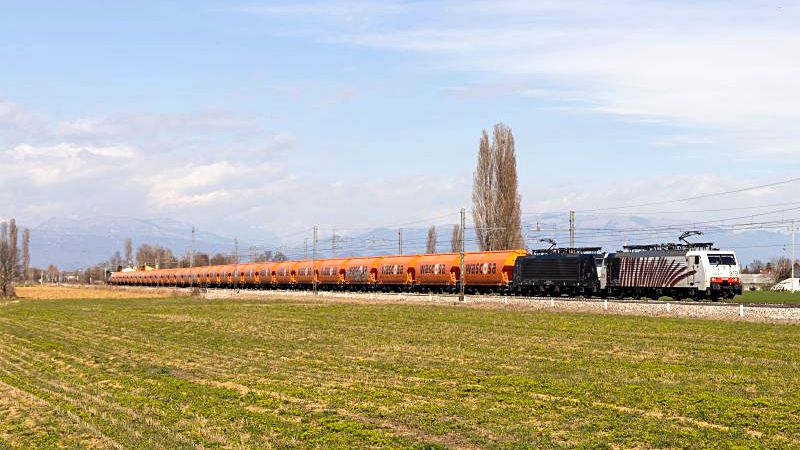
Hupac will launch a rail service on 12 January 2026 between the Duisburg Gateway Terminal DGT and Novara CIM. The connection will operate with a daily frequency, offering six round trips per week and expanding capacity between Germany and Italy. The new shuttle strengthens the operator’s presence along the Ruhr–Italy corridor, a central axis of the Rhine–Alpine corridor. Hupac is also reinforcing the role of the Duisburg terminal as a European hub, enabling more structured connections towards north-eastern and south-eastern Europe. The service will therefore allow integrated links with northern and southern Italy through the terminal network.
Hupac Barcelona terminal operational in 2026
The Hupac terminal in Barcelona, located in La Llagosta, is approaching the final phase of construction and will enter a testing phase in January for the circulation of container and semi-trailer trains. According to Hupac, a fully loaded test train from Antwerp is expected to arrive in early January. The intermodal units will be unloaded and then reloaded before the train departs back to Belgium, allowing operating procedures to be verified. The test will assess the full functionality of the terminal following a total investment of 20 million euros, carried out under the Combiconnect Barcelona joint venture between Hupac and Tpnova. The site will be equipped with gantry cranes, OCR-equipped gates and advanced IT systems for rail-road intermodal traffic. Four 700-metre dual-gauge loading tracks are also planned, compatible with both the Iberian and standard-gauge networks. Once fully operational, the terminal is set to function as a regional hub for the Barcelona metropolitan area.
Medway expands in France and Austria
Medway, the rail operator controlled by MSC subsidiary Medlog, is launching new services in France and Austria, expanding its footprint beyond its operational base in Spain and other six European countries. The first French service was operated on 14 December between Caffiers and Dunkirk for a customer in the steel industry and will run 365 days a year, with trains capable of carrying up to 3,600 tonnes of critical raw materials, including lime and limestone destined for one of Europe’s largest steel plants. On 17 December, the first operation in Austria was launched, with a three-times-weekly rail link between Linz and Wels and the port of Trieste in Italy. The service, the operator explains, is aimed at the forestry, paper and pulp, automotive and distribution sectors, which are highly dependent on north–south freight flows, and is integrated into Medlog’s intermodal network to ensure connections with other European hubs. Medway is already active in Belgium, Germany, Italy, the Netherlands, Portugal, Spain and Switzerland and is the leading private operator in the Iberian Peninsula, where it aims to acquire part of Renfe Mercancías’ activities through a joint venture.
Works start on the Szeged intermodal terminal
Construction works have begun in Szeged on Metrans’ second Hungarian intermodal terminal, with operations scheduled to start in 2027, according to the group during the foundation stone ceremony held on 12 December 2025. The new hub will strengthen Hungary’s role in European supply chains and will complement the national network alongside the Budapest terminal, which has been operational since 2017. The project covers around 10 hectares and includes four 330-metre loading tracks and two remotely controlled electric gantry cranes for fast and sustainable handling. Estimated capacity stands at six pairs of trains per day and 300,000 TEU per year. The Szeged terminal, the country’s southern gateway, is set to become a new logistics pole along the corridor between Central Europe and the Balkans. The facility will link regional industrial and commercial flows to European maritime and inland networks, supporting new investments in manufacturing, automotive, electronics, FMCG and e-commerce. The project is also expected to deliver social benefits by reducing road congestion along the M5–M43–55 axis and in surrounding towns, improving safety and quality of life, while creating new jobs and strengthening links with local suppliers.
EU investigation into Chinese mobile cranes
The European Commission has launched an anti-dumping investigation into imports of mobile cranes from China following a formal complaint lodged by leading European manufacturers. According to the Commission, the investigation concerns mobile cranes designed for lifting and handling materials on land, with a capacity of at least 30 tonnes, mounted on self-propelled vehicles. The move follows reports of a sharp increase in Chinese cranes entering the EU market at artificially low prices, with competitive effects considered manifestly unfair for European industry. As reported by the VDMA Materials Handling and Intralogistics Association, European producers have provided evidence of material injury linked to predatory pricing practices and improper advantages enjoyed by Chinese manufacturers, including public subsidies, distorted raw material costs, preferential tax regimes and favourable financing conditions. The complaint highlights an exponential rise in imports from China, with a potential impact on more than 7,000 direct jobs and tens of thousands across the supply chain. The companies involved stress the strategic role of European mobile cranes for critical infrastructure, renewable energy projects and defence activities. According to manufacturers, the European industry sustains significant investment in safety, performance and compliance with EU environmental and data protection regulations.
Green light for the sale of Moby ferries
The Lazio regional administrative court has rejected a request for interim relief submitted by Grimaldi Euromed to block the sale of five Moby ferries – Moby Aki, Moby Wonder, Athara, Janas and Moby Ale 2 – thereby allowing the ownership transfer to proceed. According to the ruling, there is currently no risk of a structural and irreversible alteration of the market’s competitive balance, also because two of the five vessels will remain available to Moby through a re-chartering clause that preserves their operability during the interim period. The judges also note that the transfer of ownership of the ships to an MSC group entity is legally reversible. The price of 229.9 million euros, resulting from a public auction, will be paid by MSC to Moby and CIN and used to extinguish a 243 million euro loan granted by the Gianluigi Aponte-led group itself. Under the agreement submitted by MSC, GNV and Moby to the antitrust authority, aimed at avoiding potential sanctions for anti-competitive conduct on routes between mainland Italy and Sardinia, any residual credit, should the proceeds prove insufficient, would be assigned to independent third parties under conditions compatible with Moby’s economic and financial sustainability.
Ownership change for the Arcese warehouse in Basiano
AEW has acquired from DWS, through an off-market transaction, a Grade A warehouse in Basiano, near Milan, with a surface area of 55,000 square metres, developed on a plot of around 100,000 square metres. The property is fully leased to Arcese, which uses it as its main European hub. The transaction was carried out on behalf of a French institutional investor, with World Capital advising both parties. The logistics hub was completed in 2018 and holds a BREEAM In-Use Good certification. The weighted average lease term exceeds 20 years, contributing to the income stability of the asset. Value drivers include direct access to the A4 motorway and its location within an already well-established industrial cluster.