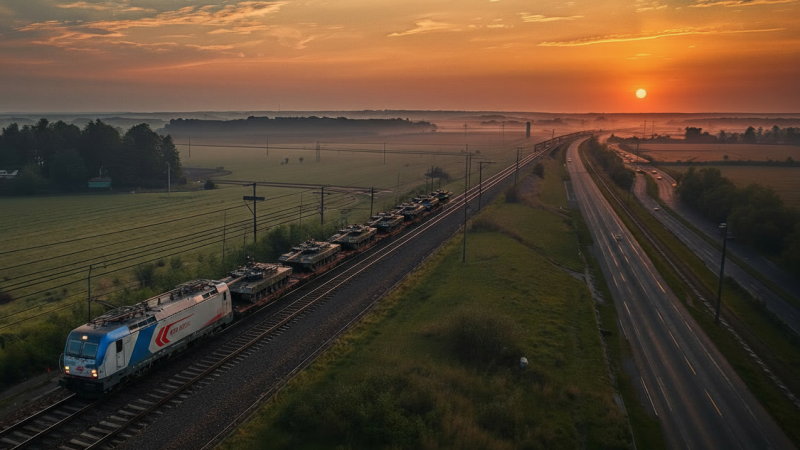





The goal is now close and is expected to be achieved in the first quarter of 2026. By that date, authorisation for entry into service on the Italian rail network is due to be granted for what promises to be a step change in freight traction: the Euro9000 family locomotive developed and built by Swiss manufacturer Stadler at its Valencia plant in Spain. Already operating on the European network and therefore proven in real-world conditions, the locomotive combines very high performance, flexible use thanks to various hybrid configurations, and competitive operating costs.
It is no exaggeration to suggest that this vehicle, designed exclusively for freight duties, could prove a trump card and a turning point for the future of rail freight on Europe’s main corridors. Its characteristics speak for themselves. First of all, it is a six-axle locomotive with an uncommon wheel arrangement, featuring two bogies with three powered axles each. Thanks to electronic management, this configuration delivers high adhesion without aggressively stressing and wearing the track, a factor that in the past represented a major limitation for heavy historic six-axle locomotives.
It is also quad-current, making it suitable for operation across the entire European network and equipped with all relevant safety systems. In addition, it can be fitted with two auxiliary modules, a diesel engine and a battery pack, which can also operate in parallel, delivering a very high maximum output of 9 MW. This compares with a modern four-axle locomotive, which typically reaches around 6.5 MW.
These capabilities exceed those of universal electric locomotives by almost 50 per cent, allowing the Euro9000 to haul heavy freight trains independently along the main Alpine routes without the need for locomotive changes or additional assistance through double or triple traction on the steepest sections. Starting tractive effort reaches 500 kN, compared with an average of around 300 kilonewtons for the best four-axle competitors. Stadler’s engineers have calculated the life-cycle cost of this locomotive family and found it consistently lower than operating two coupled universal multisystem locomotives for the same type of service.
The new Euro9000s are already approved in Germany, Austria, Switzerland, Belgium and the Netherlands. Approval for Italy is now awaited at the end of a long authorisation process that began in July 2021. Strictly speaking, some Italian operators are already using these locomotives, but on networks beyond the Alps, notably TX Logistik, Rail Traction Company/Lokomotion and LTE Italia. Numerous contracts have already been signed between Stadler and several leasing companies, including Nexrail, which has taken an option on 200 units.
Piermario Curti Sacchi