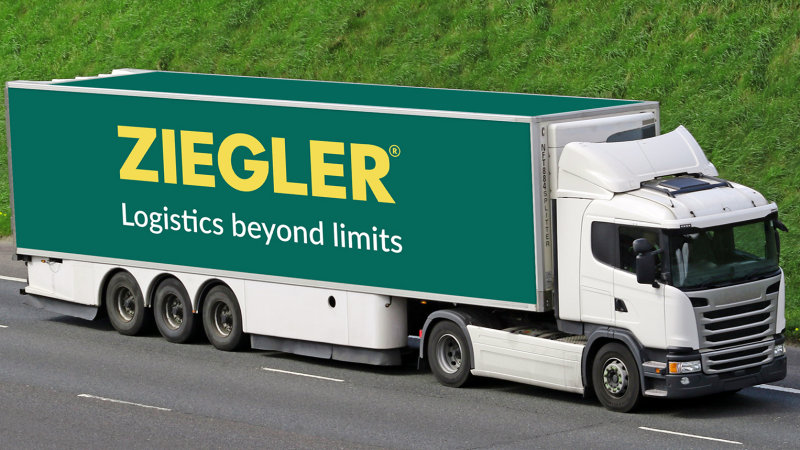






On 31 March 2026, the Lille Métropole commercial court ordered the judicial liquidation, without any continuation of activity, of Ziegler France and its subsidiary Satra, bringing the operations of the French arm of the Belgian logistics group to an end. The decision came after a month of court-supervised administration, opened on 2 March with the aim of finding continuity solutions or potential buyers, but ultimately concluded without any offers considered suitable. The ruling affects around 1,500 employees across almost 60 sites in France and stands as one of the most significant recent insolvency cases in the road freight sector.
Ziegler France, based in Roncq in northern France, operated across the full logistics chain, from domestic and international transport to groupage and integrated logistics. Its subsidiary Satra, historically established in Bapaume since 1939, represented a significant presence in transport and industrial vehicle rental. For the moment, Ziegler Services and Dornach, two IT and logistics service companies employing around 110 people, remain outside the liquidation procedure, with the court extending their observation period until 28 April 2026. A separate ruling is also expected for Transco in mid-April.
The crisis stretches well beyond northern France. Alongside the hubs in Roncq and Bapaume, the shutdown has also affected sites in Cholet, Cherré-Au, Les Herbiers, Grand-Quevilly and Saint-Étienne-du-Rouvray, with major local employment consequences. Around 80 staff are affected in Les Herbiers, more than 150 between Grand-Quevilly and Saint-Étienne-du-Rouvray, in addition to dozens of workers in Brittany and other areas. At several sites, activity stopped immediately, with yards emptied and vehicles immobilised within a matter of hours.
The deterioration in the company’s finances appears both rapid and severe. According to L’Officiel des Transporteurs, Ziegler France’s operating result moved from a profit of €10 million to a loss of €6 million in 2025, on turnover of €445 million, pointing to a sharp decline in profitability. The court also fixed the date of cessation of payments at September 2024, indicating structural difficulties that predated the opening of the insolvency procedure. Testimonies collected by Le Monde suggest that liquidity had already run out at the beginning of 2026.
The reasons lie partly in internal management and partly in market conditions. The company cited rising energy costs, the loss of major contracts and mounting pressure on margins among the main factors behind the collapse. The French road haulage sector is going through a period of significant strain, with fuel costs rising by more than 20-30% over a short period, according to figures reported by Le Monde, while operators have found it increasingly difficult to pass those increases on to customers. This has been compounded by weaker demand in sectors such as construction and industry, reducing freight volumes. The Ziegler case also underlines a structural fragility in the business model of large generalist operators, exposed to thin margins and growing dependence on subcontracting.
The speed of the procedure has intensified the social impact. In less than a month, the company moved from administration to liquidation without business continuity, leading to immediate site closures. Workers staged protests in several cities, including Vannes and Tourcoing, where employees criticised the lack of visibility over the company’s situation. The Cgt (General Confederation of Labour), through its delegate David Clairet, described the handling of the crisis as delayed and insufficiently transparent, arguing that earlier action might have allowed a less traumatic reorganisation.
Another major issue concerns the impact on the wider supply chain. The Organisation des Transporteurs Routiers Européens has warned of a possible domino effect on subcontractors, many of whom are exposed to unpaid receivables covering several months of work. The organisation estimates that hundreds of small and medium-sized companies could face difficulties in paying wages and instalments linked to industrial vehicle leasing contracts, in a sector that has already seen around 5,000 bankruptcies over the past two years. The association has called for subcontractors’ invoices to be treated as a priority within the insolvency process. Over the coming weeks, attention will remain focused on decisions concerning the companies still under observation and on any proposals for the sale of business units.
The liquidation of Ziegler France and Satra has a broader systemic significance. It is not simply the collapse of a single operator, but a sign of the pressures affecting road freight transport across western Europe: rising operating costs, shrinking margins, difficulty in passing on higher prices and a fragmented supply chain. The concentration of the effects in areas with a strong logistics and industrial base amplifies the local economic fallout, highlighting the sector’s role as a widespread source of employment and infrastructure.
Pietro Rossoni