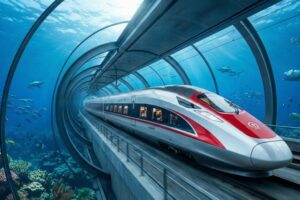







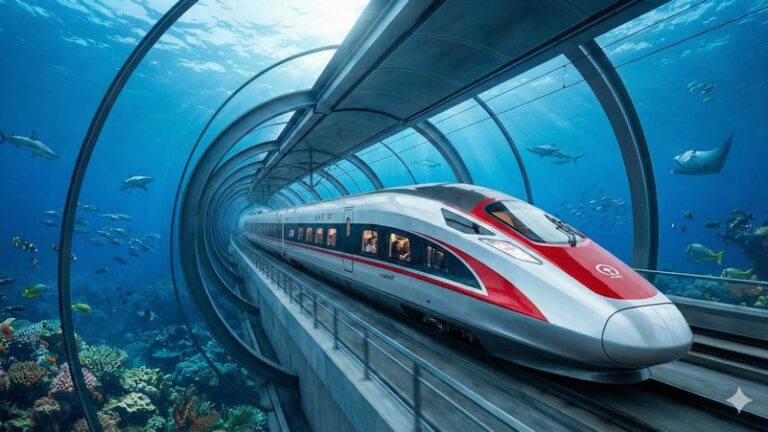
China has given the green light to the most ambitious and visionary infrastructure project ever attempted, the construction of two parallel railway tunnels stretching for more than 120 kilometres, with 90 kilometres excavated beneath the seabed. Known as the Bohai Strait Tunnel, or Bohai Strait transmarine corridor, the project will cross the stretch of sea of the same name, linking Dalian on the Liaodong Peninsula with Yantai in Shandong province. The location is in the easternmost part of China, at a relative distance from the two Koreas. The underwater section would set a new global record compared with existing infrastructure, as Japan’s Seikan Tunnel extends for 23.3 kilometres, while the Channel Tunnel between France and Great Britain is just under 38 kilometres long.
Beijing’s authorities are placing strong emphasis on the time savings for high-speed passenger services. Compared with the current ferry crossing between the two shores of the Bohai Strait, which takes between six and eight hours, the new underwater infrastructure would reduce the journey to just 40 minutes. Other rail services are also envisaged, including the possibility of loading cars onto dedicated wagons with a shuttle service between the two sides, as well as the transport of fast-moving freight, such as goods carried in roll containers.
The cost of building the Bohai Strait Tunnel is estimated at around €25 billion, but when the railway connections to the existing network are included, the overall budget rises to more than €36 billion. The Bohai tunnel is not only an unprecedented engineering challenge, but also a strategic element in completing China’s infrastructure network, as it would strengthen links between the north-eastern industrial regions, the regional economic zone and the Yangtze River Delta, historically also referred to as the Shanghai economic zone. The Bohai Strait Tunnel would therefore not merely be a symbolic flagship for Chinese engineering or a showcase for Beijing’s authorities, but a powerful logistical and economic lever.
The project is, unsurprisingly, of unparalleled scale and technical complexity, not least because it crosses a geologically sensitive area, particularly from a seismic perspective. Although the region is distant from major tectonic plate boundaries, China, like much of Asia north of the Himalayan range, experiences infrequent but sometimes severe seismic activity, as demonstrated by the Pyongyang earthquake in 1952 and the Tangshan earthquake of 1976, which occurred on the northern shore of the Bohai Gulf roughly 100 kilometres from the planned tunnel route.
Chinese engineers, and in particular China Railway Engineering Corporation (Crec), a state-owned holding company and one of the world’s largest transport infrastructure contractors, are fully aware of the complexity of the challenge. They nonetheless intend to proceed using the most advanced technological innovation to manage and monitor every phase of construction and, above all, the future operation of the tunnels, with cutting-edge emergency systems. One aspect that may seem striking from a European perspective is the estimated construction timeframe, expected to be around ten years or just over.
Piermario Curti Sacchi