








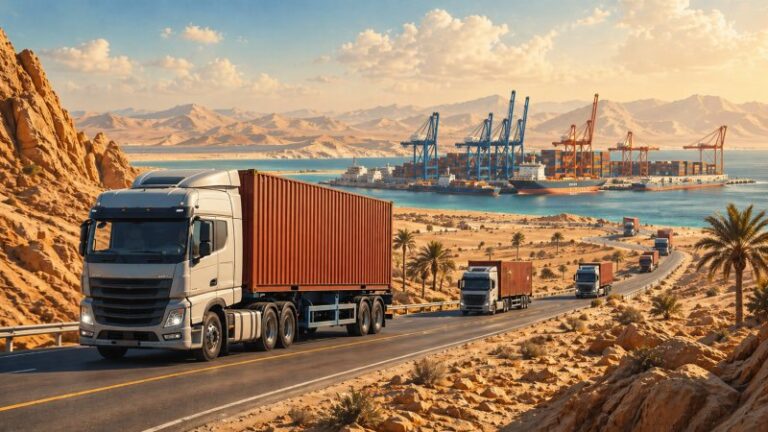
Use of Maersk’s Saudi Landbridge services increased in October 2026, a trend the company expects could continue into November. According to its regional update for India, the Middle East and Africa dated 9 November, operational difficulties at Khor Fakkan port and disruption in the Strait of Hormuz drove demand for overland connections, prompting customers to seek alternative routes to Saudi Arabia and other Gulf countries. Maersk uses the Landbridge name for several services that involve transporting containers by road for part of their journey.
In operational advisory No. 53, dated 6 November 2026, Maersk confirms that Saudi import and export cargo continues to move through the Red Sea port of Jeddah, including shipments to Riyadh and Dammam via the existing Jeddah Landbridge service. Some shipments booked for Khor Fakkan are instead discharged at Fujairah, with onward transport under customs bond to Jebel Ali and other destinations in the United Arab Emirates. Cargo bound for Kuwait, Iraq, Qatar, Bahrain and the UAE follows a sea–land–sea route: it moves through Salalah and Khor Fakkan, continues by road to Sharjah and then uses shipping connections between Gulf ports, without passing through Jeddah. This is separate from the Saudi Landbridge railway project, which is intended to connect Jeddah with Riyadh and the network towards Dammam, with a possible opening in 2034.
However, the hubs chosen to diversify routes face capacity constraints. At Khor Fakkan, according to the 6 November advisory, berth availability is limited, yard occupancy is high, and truck queues and delays in cargo collection persist. Containers are being transferred to Sajja ICD to ease pressure on the terminal. Fujairah also faces operational constraints and high yard occupancy, with some laden containers bound for Jebel Ali being moved to the off-dock depot at Al Hayl pending onward transport.
Meanwhile, Maersk continues to suspend bookings on several overland routes: cargo from the UAE and Qatar via Jeddah and Omani ports; from Jeddah to the UAE, Oman and Qatar; and from Salalah and Sohar to the UAE, Saudi Arabia, Kuwait, Bahrain and Qatar. Alternative routes may extend transit times and incur additional transport, handling, customs clearance and storage costs. Maersk recommends checking capacity availability and customs and border procedures in advance, particularly for urgent or high-volume shipments.