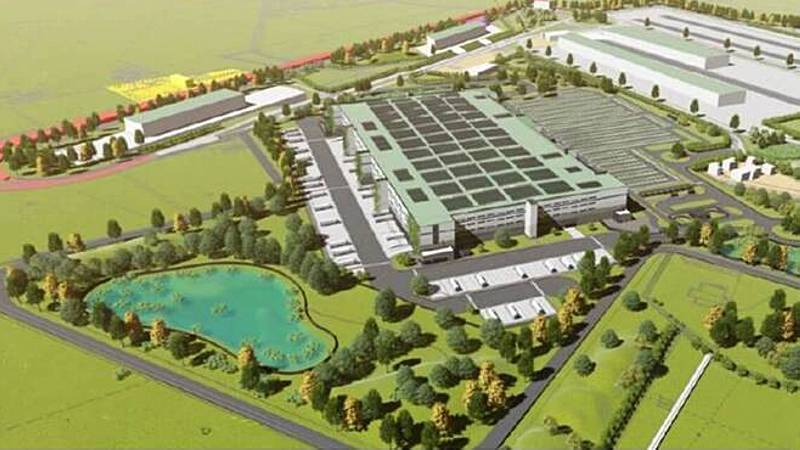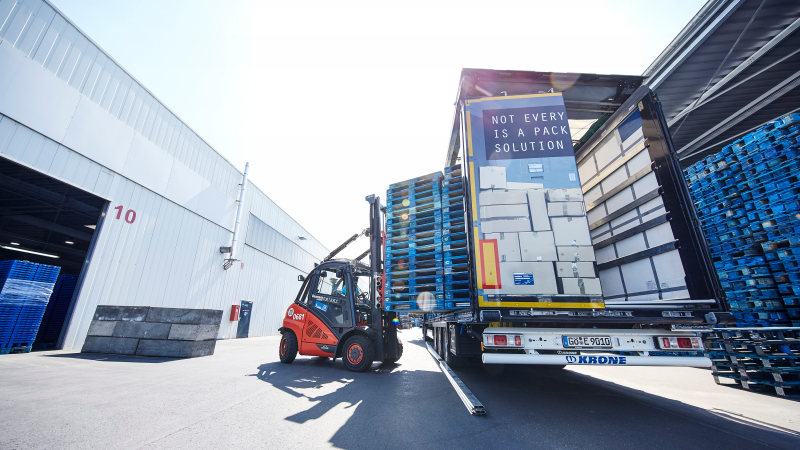







The second section of the Ulm intermodal rail terminal, located in the Baden-Württemberg region of southern Germany, is due to open in 2027. The upgrade is at an advanced stage of construction and will double the facility’s annual handling capacity, rising from 120,000 to 300,000 loading units. The expansion strengthens Ulm’s role as a key hub for combined transport in southern Germany, within rail corridors that to the north connect with German seaports, the Maschen rail yard south of Hamburg – the largest in Europe – and to the south with Italy via Austria.
The new module under construction will be equipped with three fully automated gantry cranes operated remotely via video control stations. The project includes the installation of four additional railway tracks, five parking lanes for road vehicles, and dedicated lanes for entry, loading and exit. Operations will be optimised through a slot booking system which, in addition to reducing waiting times, is expected to help limit congestion not only within the terminal but also on surrounding roads, aided by the construction already under way of a new interchange on the A8 motorway. The second module will also offer an opportunity to improve and streamline rail access, with new entry and exit tracks directly connected to the Stuttgart–Ulm line, avoiding the constraint of freight train shunting at Beimerstetten.
In December 2022, the new high-performance main railway line between Wendlingen, south of Stuttgart, and Ulm was completed and opened to traffic. The line crossing the Swabian Jura (Schwäbische Alb) is just under 60 kilometres long. Despite its relatively limited length, the new railway plays a leading role in strengthening the entire rail network in southern Germany.
In particular, it reinforces routes that previously had to contend with limited residual capacity and the resulting negative impacts on traffic, especially freight services forced to give priority to passenger trains, a constraint well known to operators across Germany. For this reason, the Wendlingen–Ulm line, in addition to enabling fast connections between Stuttgart and Munich, has the positive effect of relieving traffic on the traditional Filstal line, which, thanks to the greater capacity available, can primarily benefit freight transport.
The line therefore also represents a central element of the Rhine–Danube corridor within the Trans-European Transport Network (TEN-T). In this case, the southern branch is involved, running from Strasbourg through Stuttgart and Munich and reconnecting with the main route towards Romania and the Black Sea ports of Constanța and Sulina.
Piermario Curti Sacchi