







Assarmatori’s study on the relocation of container transhipment operations outside the European Union, presented on 4 November 2026 at the European Parliament in Brussels, identifies changes potentially linked to the EU Emissions Trading System (ETS) in 41 of the 86 shipping services examined. Conducted by Giovanni Satta, associate professor in the Department of Economics at the University of Genoa, the research covered services calling at Gioia Tauro, Marsaxlokk, Sines and Taranto, including cases where calls at European hubs were replaced by calls at competing ports in third countries. The study also reports increased investment in North African terminals since the maritime sector came under the ETS.
Under the short-term scenario, which assumes that 7.5–15% of the volumes at risk move elsewhere, calculations by T.I.M. 10 Srl, carried out under Satta’s supervision, put the associated annual revenue at between €403 million and €892 million. The container traffic concerned ranges from 2.85 million to 6.30 million TEU, with equivalent investment of €1.43–3.60 billion in the capacity needed to handle it and activities supporting 2,005–4,431 jobs.
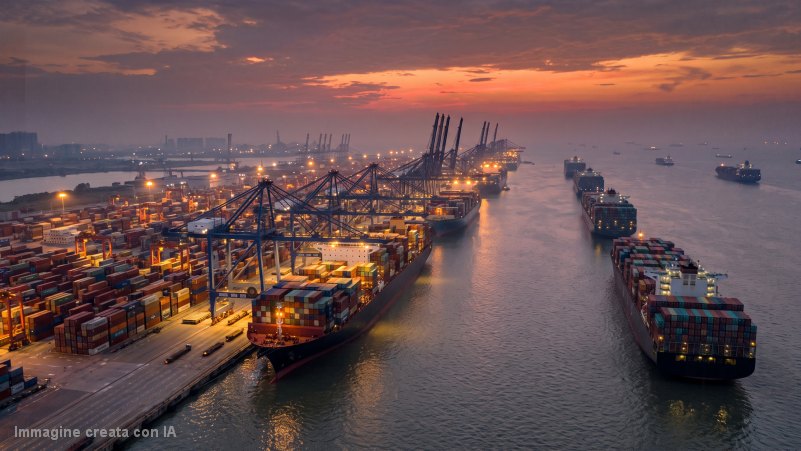
Transhipment, the study stresses, is highly sensitive to differences in operating costs between competing hubs and, unlike traffic serving local markets, can readily shift between alternative ports within the same international network. Once shipping services and terminal investment leave Europe, winning them back becomes virtually impossible. Anti-evasion measures can counter intermediate port calls designed to circumvent the rules, but cannot prevent operations from relocating outside the EU. Such relocation allows cargo bound for non-European markets to avoid voyage legs covered by the ETS while maintaining links with Europe through feeder services. Tightening existing restrictions without a complementary measure to encourage transhipment in Europe would therefore leave the underlying economic imbalance driving relocation unresolved.
Assarmatori secretary general Alberto Rossi said that ongoing conflicts had shown what happens when a strategic passage outside one’s direct control is disrupted. Shifting transhipment to Africa, he explained, risks turning the continent into a new logistical and geopolitical chokepoint, bringing congestion and strategic dependence to global supply chains. The European Union cannot control the security of hubs beyond its borders, while investment in African port concessions often comes from global private operators and foreign governments, particularly China. Rossi argued that entrusting critical transhipment nodes to hubs controlled by geopolitical rivals exposes Western economies to deliberate disruption and retaliation. Cesare Crocini, head of the association’s Brussels office, added that the logistical security of Italy and Europe was at stake, alongside port competitiveness, the relocation of traffic and jobs. He said that anyone opposing an ETS adjustment in favour of transhipment “betrays the spirit of the Union”.
Among the proposals put to the European Parliament and the Council of the EU, Assarmatori regards the compromise promoted by MEP Peter Liese in the week before the workshop as the most promising basis for progress. According to the association, the latest version would better reflect competing services and strengthen the incentive to retain long-haul hub operations in Europe. It combines an incentive linked to the share of transhipment cargo at EU ports with an adjustment based on distance travelled, covers both inbound and outbound voyages, and lowers the size threshold for eligible ships from 10,000 to 5,000 TEU.