


On 22 May 2025, during a television interview on Bfmtv, Sncf president Jean-Pierre Farandou put forward the idea of financing the expansion of the rail network – which requires at least one billion euros annually – through a levy on industrial vehicles travelling on French roads. The proposal, inspired by the German model that generates eight billion euros a year through lorry tolls (including for German vehicles), has drawn criticism from French road transport associations. They argue the measure is legally unenforceable and fear negative consequences for a sector already in difficulty.
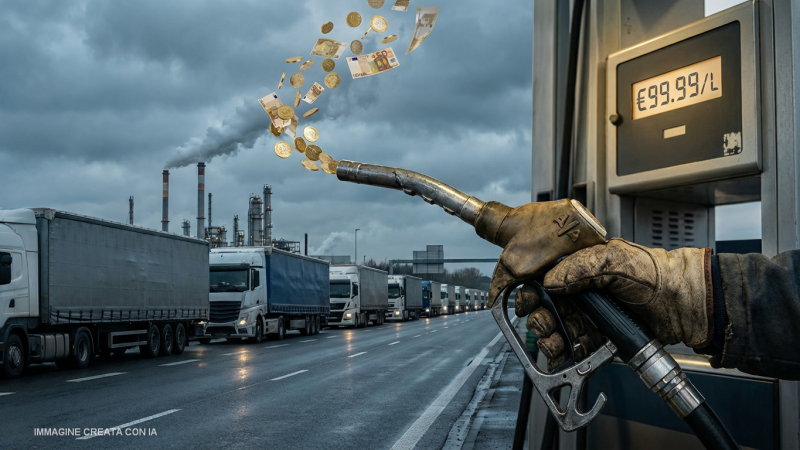
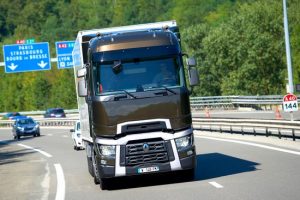
The idea revisits the concept of the ecotaxe, a short-lived measure abandoned in 2014 following protests from the "yellow vests", although it has recently resurfaced at regional level. Jean-Pierre Farandou justified his proposal by pointing to France's geographical position as a transit country between northern and southern Europe. During the interview on Bfmtv, he stressed that France is "heavily crossed by lorries" that often "fill up in Luxembourg" with their 1,000-litre tanks and "cross the country without even refuelling".
According to the Sncf president, this situation brings France "only the disadvantages" of heavy vehicle traffic – such as air pollution and road deterioration – "without any gain" in terms of fuel tax revenue, though it should be noted that French motorways are toll roads. Farandou also pointed out that many foreign lorries "take the French side to skirt Germany and descend through France" to avoid the German toll system. However, this traffic deviation could be used as a counterargument, as it demonstrates how national fiscal policies can significantly influence continental transport flows, potentially distorting competition.
The proposal is grounded in the "polluter pays" principle and the urgent need to find additional resources for the rail system. Farandou stated that "it would not be unreasonable to ask for a contribution for the use of the French national asset that is our road and motorway network" and to seek "a contribution to the fact that, since pollution is being caused, it might not be unreasonable to help fund the non-polluting rail sector".
In a joint statement issued on 23 May, the Fédération Nationale des Transports Routiers (Fntr), the Organisation des Transporteurs Routiers Européens (Otre), and the Union Transport et Logistique de France (Union Tlf) expressed their strong opposition. The road transport associations called this a "red line" for a sector "already bled dry" and firmly declared: "We do not want it." The main objection is legal feasibility. According to the transport organisations, "targeting foreign lorries alone is legally unenforceable. European law requires equal treatment among carriers: in practice, it will be French companies that pay."
The economic situation of the French road haulage sector is already precarious. The associations highlight that "French road transport has the lowest margins in Europe, is undergoing an unprecedented crisis, and already bears over four billion euros in specific taxation each year." Since the suspension of the ecotaxe in 2014, the sector has absorbed a tax increase of four cents per litre of diesel, equivalent to 600 million euros per year. Under no circumstances, argue the sector’s representatives, can hauliers bear any additional financial burden.
Faced with the controversy triggered by the proposal to tax lorries, alternative suggestions are emerging to source the necessary funds for the rail system. Both Farandou and the road transport associations agree on one such alternative: using revenues from motorway concessions. France has 9,200 kilometres of toll-concession motorways. Although industrial vehicles account for only 15–20% of traffic, they generate 33% of toll revenue. The concessions expiring between 2031 and 2036 generate around 13 billion euros in annual turnover, representing a potential source of funding for transport infrastructure.
Meanwhile, as mentioned, the idea of a universal ecotaxe on all industrial vehicles, regardless of nationality, is resurfacing. A concrete example is found in Alsace, where the Collectivité Européenne d'Alsace voted in October 2024 to introduce a tax called the R-Pass. Scheduled to come into effect in 2027, this measure will impose a tariff of 0.15 euros per kilometre on lorries over 3.5 tonnes travelling along the north-south axis (A35 and A36) and two other roads linking this axis to Germany. The aim is to generate around 100 million euros annually for road maintenance, given that more than 50% of the network requires exceptional repairs.
Rail freight in France currently accounts for only 10% of the market, a lower share than in other European countries such as Germany and Switzerland. Farandou's objective of doubling this share to 20% would require massive investment, estimated at 100 billion euros. However, this ambitious plan to develop rail transport faces the stark reality of insufficient public funding.