

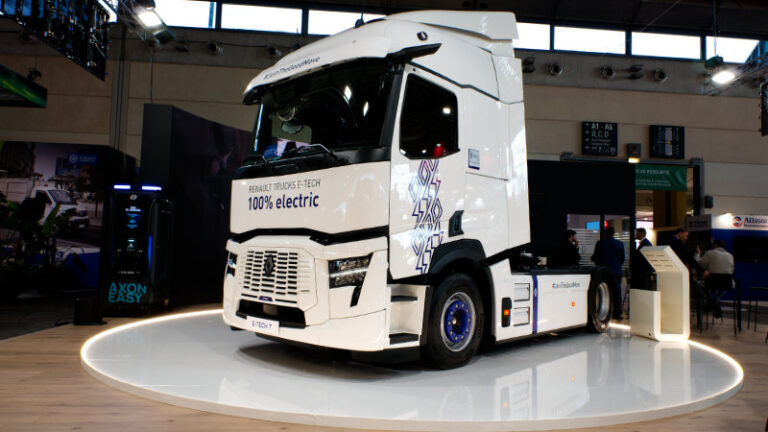
At the Rimini event, Renault Trucks’ choice to display only an electric tractor sent a clear message: the brand intends to stay firmly on course with electrification, a field in which it has long been a pioneer. This, despite Italy’s significant delays. During its press conference, the company outlined the current state of the energy transition in European heavy transport, stressing how Italy remains on the sidelines of the electric revolution. Today, electric trucks over 16 tonnes represent just 2% of the European market, but the average conceals vast disparities: in Switzerland the figure approaches 14%, while in Italy it stands at only 0.2%. “There’s no team play,” summarised Marco Bonaveglio, Sales Director of Renault Trucks Italia, pointing to the lack of coordinated policies, effective incentives and suitable charging infrastructure.
According to data presented by the company, the map of Renault Trucks’ electric vehicles shows a two-speed Europe: northern urban areas such as Paris, Amsterdam, Berlin and Zurich are brightly lit by a dense network of operational vehicles, while Italy remains almost devoid of activity. The delay, executives explained, is not technological – the industrial platform is already mature – but rather economic and logistical, with the necessary conditions for large-scale deployment still missing.
Renault Trucks has been producing battery-electric vehicles since 2008 and now counts nearly 3,000 units operating across Europe, covering a total of 80 million kilometres. In Italy, 119 zero-emission vehicles from the brand are currently on the road, mainly serving waste collection, urban distribution and refrigerated transport. This fleet has already saved over 79 tonnes of CO₂, bringing Renault Trucks’ electric share of production to 3%, compared to a European market average of 2%.
As Bonaveglio explained, selling an electric truck goes well beyond vehicle delivery and involves a consultancy process: from analysing transport missions to designing the charging infrastructure, every project is tailored to the customer. Andrea Rossini, Energy Transition Manager, noted that the company now offers the most comprehensive electric range on the market, from the light Trafic E-Tech to the 44-tonne tractor. In 2026, the D12 E-Tech will debut with cost-effective LFP batteries, while the flagship tractor will offer up to 400 kilometres of range. By 2027, the T Extended, designed for long-haul routes and equipped with eight battery packs integrated into the chassis, is expected to arrive.
Among the upcoming innovations, the Flexis family stands out — a range built on a native electric platform with centralised software architecture. It includes three versions: a cab chassis for specialist bodies such as waste collection or light construction; the “step-in van”, allowing direct access to the cargo area and intended for urban or healthcare distribution; and the “panel van”, a compact low-floor vehicle for refrigerated or pharmaceutical transport, also suitable for supermarket basements. All models feature zero local emissions, high manoeuvrability and low operating costs.
In Italy, Renault Trucks’ experience is expanding through concrete case studies: in Milan, it supplies vehicles to Amsa for waste collection; in Umbria, it collaborates with LC3 for refrigerated transport; and in Vicenza with Zordan for furniture distribution. “We are now targeting the construction segment, where there is clear potential for electrification,” said Andrea Porchietto, Key Account Manager Bodybuilders.
The main obstacles to electrification remain overall cost and charging management. Michele Leoni, Service & Network Development Director, outlined the company’s integrated approach: each project includes infrastructure assessment, energy management and connected services. Charging solutions range from rapid DC stations up to 400 kW to slower options at 22 or 44 kW, ideal for overnight depot charging. In partnership with Italian energy operators, Renault Trucks also offers dedicated photovoltaic systems and energy management tools to optimise consumption.
The Serenity Pack contracts include predictive maintenance, full battery warranty and remote operational monitoring. Vehicle connectivity enables real-time efficiency checks and reduces downtime. “We don’t offer a standard solution but a complete sustainable transition project,” concluded Leoni, summarising the philosophy driving Renault Trucks’ decarbonisation strategy for heavy transport in Europe – and, hopefully, soon in Italy as well.