



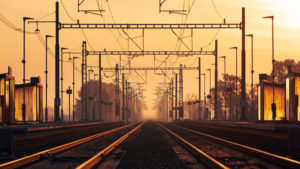
Major infrastructure projects are not always required to achieve significant results, because decisive progress can also come from targeted, limited interventions. This is the case with the works now ready to get under way from April 2026, affecting the complex rail hub of Basel, the city in northern Switzerland that serves as a gateway to Germany and France. The project covers a section of less than five kilometres, from central Basel (Basel SBB) to St. Johann (Basel St. Johann), the border station towards France. Approval for the project was granted by the Federal Office of Transport on 17 December 2025.
Why does this project matter so much? Because it involves adapting the rail profile to allow intermodal trains to operate without loading gauge restrictions, what in Switzerland is known as the four-metre corridor. This short section is the critical gateway to the railway along the left bank of the Rhine, which is to be upgraded as a high-capacity European freight corridor, providing an alternative to the existing line on the right bank. At present, the right-bank route is the only one suitable for intermodal traffic, but it is congested and not without risks, particularly in the event of incidents such as the Rastatt derailment in 2017, which brought rail traffic to a complete standstill for almost two months.
The Rhine–Alpine axis, one of the busiest in Europe, clearly illustrates how rail freight depends vitally on alternative routes to remain competitive. The railway line along the left bank of the Rhine not only suffers from infrastructure constraints in terms of loading gauge, but also includes sections that are not electrified, forcing railway undertakings to change locomotives and resort to diesel traction. Remarkably, the bottleneck begins in Basel itself, in Switzerland, the country that has shown the strongest commitment to enhancing this alternative route. Basel is, in effect, the gateway to the left-bank Rhine railway.
The planned works involve an investment of more than €120 million and include lowering the track level and adapting the overhead line equipment in two tunnels, which will also be refurbished. Two overpasses and a river bridge will also be upgraded. Technically, the works could be completed within two years, but Swiss Federal Railways have opted to spread them over almost four years in order to minimise line closures and limit the number of cancelled trains as much as possible.
Bringing the northern section of the Basel route up to standard loading gauge is a necessary step towards upgrading the entire left-bank Rhine rail corridor. In recent years, Switzerland has declared its willingness to directly finance the necessary works along the whole Basel–Strasbourg–Metz axis. Bern’s authorities have already opened their wallets on other occasions, including support for Italian railways, which received a non-repayable contribution of more than €260 million to upgrade the international Luino line towards the Gotthard, as well as the route via Domodossola and the Simplon, where works are still under way.
This commitment has deep roots. Under a 1955 Italo-Swiss convention, Switzerland financed the electrification of the Novara–Alessandria railway, essential for reaching the port of Genoa. Grant funding beyond national borders therefore highlights the extent to which Switzerland intends to invest in rail freight.
Piermario Curti Sacchi