






The Swiss Federal Council has taken a step in the right direction, yet once again it has overlooked the rail infrastructure in the south of the country, in other words the essential routes leading to Italy. This is the assessment expressed by the Pro Gottardo Ferrovia d’Europa interest group regarding the decision taken by the Swiss Government’s executive body on 19 November 2025.
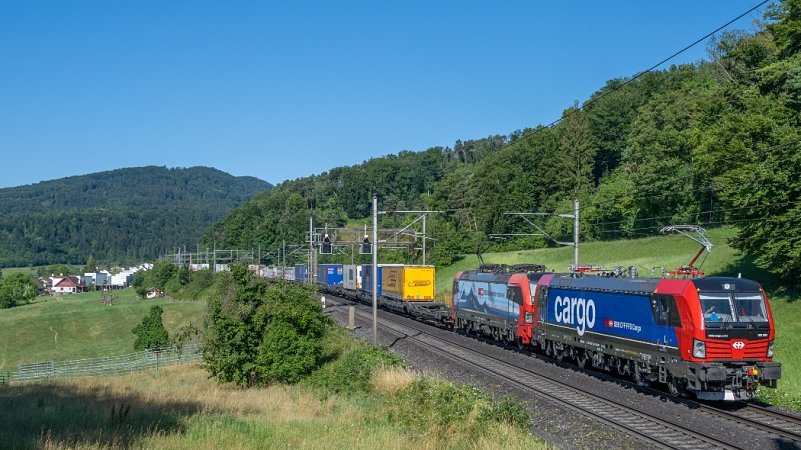
On that occasion, the Federal Council announced its intention to step up efforts to upgrade and modernise the railway approaches to the base tunnels along the transalpine corridor known as the Alptransit project, which includes the Gotthard, Ceneri and Lötschberg tunnels. It also plans to introduce financial incentives for combined transport and invest in digitalisation. These measures, aimed at strengthening transalpine rail freight, which lost ground between 2022 and 2024, however focus exclusively on the northern access routes from Germany and France.
This is clearly confirmed by the federal document. By 2028, the Stuttgart–Singen corridor and its Swiss extension from Schaffhausen to Oerlikon and Othmarsingen will be upgraded to ease congestion on the German section of the Rhine Valley and provide an alternative route. Furthermore, under a declaration of intent signed with France, work began in 2025 to upgrade a railway line on the left bank of the Rhine, which could in turn become an efficient Alptransit access route for freight traffic. On the Swiss side of this northern corridor, two tunnels near Basel are to be enlarged, with main construction works scheduled to start in 2026.
According to Pro Gottardo Ferrovia d’Europa, the Federal Council is forgetting “that southern access routes also exist, where modernisation has begun but is far from being secured within reasonable timeframes. It merely tackles short-term issues without any overall vision or strategy for the future, showing limited foresight”. Moreover, while in northern Switzerland the measures include infrastructure upgrades such as four-track expansion and line improvements, south of the Alptransit base tunnels the focus is solely on adjusting tunnel profiles to make them suitable for unrestricted intermodal trains. Most of this work has already been completed, except for the Domodossola–Gallarate line, where construction will continue in phases until 2028.
In practice, once again, the view prevails among many French- and German-speaking Swiss cantons that consider the transalpine railway corridor project complete since the base tunnels entered service, shifting their attention to central Switzerland. Yet many elements are still missing for a genuine strengthening of this railway axis, which ideally runs from Rotterdam to Genoa and is crucial above all for supporting transit traffic across Switzerland.
The Confederation should also step up its efforts through bilateral agreements with all the European countries involved. According to Pro Gottardo, “targeted short-term improvement measures are welcome, but at the same time the completion of the transalpine axis must be properly planned, from north to south, from Rotterdam to Genoa. A genuine policy of coordination with European partners is urgently needed, rather than vague hopes that neighbouring countries will take action”.
Piermario Curti Sacchi