



Maersk expands Malaysian logistics
Maersk has inaugurated its largest contract logistics centre in the Asia-Pacific region, the Mega Distribution Centre in Shah Alam, boosting its warehousing capacity in Malaysia by 30%. Covering about 180,000 square metres, the facility offers 100,000 pallet positions and hosts clients from a range of sectors, including fast-moving consumer goods, food, footwear and apparel. The new hub is directly connected to major road arteries — including the North-South Expressway, Elite Highway and Shah Alam Expressway — ensuring shorter transit times to industrial areas, Port Klang and Kuala Lumpur Airport. Located around 340 kilometres from the Port of Tanjung Pelepas, Maersk’s main transhipment hub in Asia, the centre supports regional distribution and intermodal connections. The Mega DC integrates daily road transport to cities such as Ipoh, Penang, Johor, Malacca and Kota Bharu, alongside multimodal sea, air and land solutions across East Asia. The warehouse strengthens interconnections between ports, airports and retail networks, enabling a continuous flow of goods and reducing delivery times. The facility features advanced automation systems, including autonomous mobile robots, Put-to-Light technology and an automated storage and retrieval system (ASRS), improving order accuracy and processing speed. It also incorporates a transport management system and a warehouse management system with EDI interface, ensuring real-time traceability.
New container terminal in Jeddah
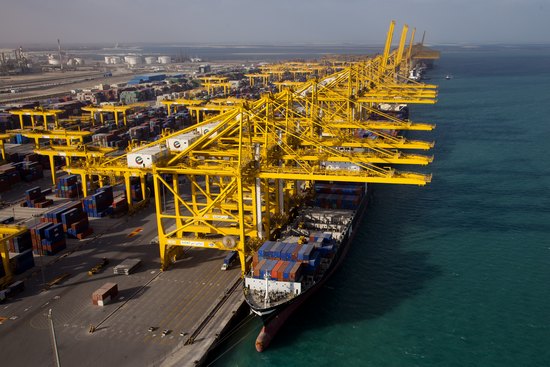
Red Sea Gateway Terminal (RSGT) and CMA CGM Group, through its subsidiary CMA Terminals, have signed a preliminary agreement to establish a joint venture for the construction and operation of Terminal 4 at Jeddah Islamic Port. The planned investment amounts to 1.7 billion Saudi riyals (USD 450 million) for a new facility with a capacity of 2.6 million TEU. The project includes the installation of state-of-the-art handling equipment and the adoption of innovative digital and sustainable solutions. This initiative is part of the port’s expansion strategy, in line with the concession agreement signed in 2020 with the Saudi Ports Authority, Mawani. The sub-concession will be structured within RSGT’s existing long-term contract, allowing the operator to further expand the operational capacity of the Kingdom’s main gateway.
CMA CGM reorganises Medex service
CMA CGM has announced an overhaul of its Medex service with the introduction of a new link via Alexandria and Beirut, aimed at strengthening connectivity between the Mediterranean, the Indian subcontinent, the Middle East Gulf and the Red Sea. The new configuration seeks to cut transit times and extend coverage in both directions, using the two ports as regional hubs. The service will maintain a weekly frequency to ensure regular and reliable connections. The extension through the Levant will enhance integration with East Mediterranean routes, in coordination with the company’s SSL Mediterranean services. The first import call in Alexandria took place on 6 November 2025 with the vessel CMA CGM Mozart, while the first export call from Beirut was completed on 23 October 2025 with the CMA CGM Titus.
Dongfeng chooses Livorno as entry point for its cars
The Port of Livorno is consolidating its position as a key entry point for logistics flows between Asia and Europe. In early November, more than 1,100 Dongfeng vehicles were unloaded at the port, marking a new step in the reorganisation of automotive supply chains. Ground operations were handled by XCA, the Chinese manufacturer’s logistics provider for Italy and Europe. Activities took place at the “Il Faldo” compound in Collesalvetti, one of Europe’s largest automotive logistics facilities, featuring internal rail links and integrated services such as pre-delivery inspection, workshop and customs operations. Since May 2025, the site has been managed by XCA, which has relaunched its full international operations.
Harren Group partners with Orca AI
Harren Group has entered into a partnership with technology firm Orca AI to enhance the safety and operational efficiency of its fleet of heavy-lift, multipurpose, deck carrier and bulk carrier vessels. The agreement marks an important step in the German group’s strategy towards a data-driven safety culture. According to the company, its new vessels, already equipped with zero-emission propulsion systems, will now feature the Orca AI platform, enabling continuous monitoring of navigation behaviour. The system combines the onboard SeaPod module, which provides real-time visual and thermal detection, with the FleetView onshore dashboard that aggregates and analyses operational data. The goal is to reduce incidents and near-miss manoeuvres while improving crew training and coordination between ship and shore teams. The collection of video and navigational data will also allow post-voyage reviews and targeted updates to safety protocols.