







Ceva expands Tarragona terminal
Ceva Logistics is strengthening its presence in Spain with a strategic €9 million investment to expand and modernise finished vehicle logistics operations in the La Laboral area, next to the port of Tarragona. The project includes new equipment and an additional 94,000 square metres of operational space, protected by anti-hail netting. The expansion will increase site capacity by a further 4,500 vehicles, in response to growing regional demand. Upgrades will also cover workshop facilities, including a new wash tunnel and the refurbishment and extension of paint booths. Improvements are also planned for vehicle storage and distribution processes, with the aim of supporting higher operational volumes across the Mediterranean basin. Ceva Logistics notes that the Tarragona site will operate across more than 65 hectares, with a total capacity of 32,500 units. The company links this capacity to expanded storage areas, immediate proximity to the port, available rail connections, on-site workshops and distribution activities. The investment further consolidates Tarragona’s role within the group’s Spanish finished vehicle logistics network.
Gulf logistics bridge
Mawani and Gulftainer have launched a land transport link between Sharjah and Dammam to strengthen logistics integration between the United Arab Emirates and Saudi Arabia, following the closure of the Strait of Hormuz. The initiative connects land and maritime transport networks with the aim of accelerating cross-border cargo flows, improving supply chain efficiency and facilitating access to regional markets. The corridor will link seaports with inland logistics hubs, enabling more coordinated cargo movement between the two markets. The trade bridge will leverage the Khorfakkan Inland Corridor, the Khorfakkan Commercial Terminal and the Sajaa Dry Port to build an integrated logistics solution. The combination of inland infrastructure and sea-land connections is expected to enable faster direct transport between Sharjah and Dammam, improving flow continuity and reducing bottlenecks. The initiative is also positioned as a tool to cut transit times, increase route reliability and support trade growth across the Gulf. The development follows recent progress in regional connectivity, including the launch of the Green Corridor between Oman’s ports and Dubai for maritime and air shipments. In this context, the new Sharjah–Dammam axis is presented as supporting distribution, supply chain resilience and the expansion of regional trade.
Two cargo aircraft for Ethiopian
Ethiopian Airlines has signed two leasing agreements with AerCap for Boeing 777-300ERSF aircraft converted from passenger to freighter configuration, with deliveries scheduled for the second quarter of 2028. The 777-300ERSF will be the first aircraft of this type to operate in Africa and will strengthen the carrier’s cargo capacity. The aircraft will be converted by Israel Aerospace Industries, which in 2025 obtained supplemental type certification from the US Federal Aviation Administration (FAA) and the Civil Aviation Authority of Israel (CAAI) for the programme. AerCap is involved in the 777-300 conversion programme and delivered the first two 777-300ERSF units to launch customer Kalitta Air last September. Ethiopian Airlines currently operates four Boeing 737-800P2F, two Boeing 767-300P2F, two Boeing 767-300F and 12 Boeing 777F aircraft. The 777-300ERSF offers 25% greater capacity than smaller long-haul twin-engine freighters, with expected gains in cost efficiency and cargo platform growth.
Middle East crisis boosts LH Cargo
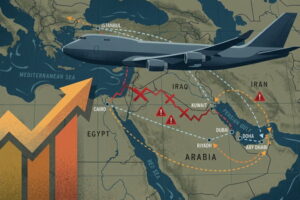
According to Bloomberg, the conflict in Iran has reduced global air cargo capacity by between 18% and 20%, due to disruptions affecting Middle Eastern carriers such as Emirates, Qatar Airways and Etihad. In this context, Lufthansa Cargo has recorded a 10% to 15% increase in demand over the past week, with particularly strong growth in India and Southeast Asia. The airline has introduced four additional cargo flights to India, while volumes from Southeast Asia have risen by around 40%. Demand is being driven by shippers seeking reliability in a highly volatile operating environment. The group has also benefited from the reallocation of logistics flows, supported by expanded passenger services to Asia and Africa used for belly capacity. However, uncertainty remains, linked to potential fuel shortages in the Strait of Hormuz and delays in deliveries of new Boeing 777-8 aircraft, now expected in 2030. Additional challenges stem from internal labour tensions and the suspension of flights to parts of the Gulf due to airspace closures. Demand is also supported by shipments of data centre servers, pharmaceuticals and e-commerce flows, although future European regulations may affect the latter segment.
ONE grows in Busan
Ocean Network Express (ONE) has signed a long-term strategic agreement with Dongwon to acquire an indirect but significant stake in Dongwon Global Terminal Busan, a container terminal currently under construction at the South Korean port. The project concerns the country’s first fully automated terminal, which, once completed, will feature six berths and capacity exceeding 4.5 million TEU. ONE’s entry into the terminal reflects a broader strategy among major shipping lines to strengthen direct control over port infrastructure in order to secure capacity and enhance operational stability. For ONE, the agreement is intended to improve service reliability and network continuity, particularly on intra-Asian routes and across its global network. The Busan project also forms part of the wider digitalisation and automation of ports, aimed at increasing efficiency, productivity and competitiveness.