








Lufthansa has announced a further reduction in domestic traffic for summer 2026, with around one hundred weekly connections to be cancelled. The group’s CEO, Carsten Spohr, said in an interview with Welt am Sonntag on 18 October 2025 that without a decrease in localisation costs “further cuts will be unavoidable”. Routes under review include Munich–Münster/Osnabrück and Munich–Dresden, both already operating at a loss. In Münster’s case, the elimination of the Munich route would mean losing the only direct access to one of the group’s intercontinental hubs. In its 2025/2026 winter schedule, the German airline had already reduced flights departing from Bremen, Cologne, Leipzig, Nuremberg and Stuttgart. Some domestic routes, such as Munich–Leipzig and Münster–Frankfurt, have already been scrapped due to lack of profitability, while Paderborn and Friedrichshafen airports are no longer served.
According to Spohr, the main reason behind these cuts lies in the doubling of localisation costs compared with 2019. German government fees for air transport include the air traffic tax, airport security charges and air traffic control fees. Lufthansa estimates that the take-off of an Airbus A320 from Frankfurt now costs a total of €4,850, compared with €2,180 in Rome and €690 in Madrid. On 1 May 2024, the air traffic tax was increased by a further 20%, reaching €15.53 for intra-European flights and €70.73 for routes exceeding six thousand kilometres.
In 2025, the air security levy also rose to €15 per passenger, adding an estimated €1.2 billion burden across the sector. These fiscal measures have severely affected an industry in Germany that has yet to recover pre-pandemic levels. According to the Arbeitsgemeinschaft Deutscher Verkehrsflughäfen association, German passenger traffic in 2025 reached 88% of 2019 volumes, compared with a European average of 113%. The domestic segment remains the hardest hit, with recovery ranging between 17% and 20%.
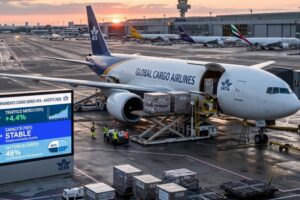
Air cargo transport is also suffering from the same dynamics. Reduced frequencies on domestic routes have limited belly cargo capacity, affecting internal flows and fast connections between the Frankfurt and Munich hubs and regional airports. According to Lufthansa Group data, total domestic cargo traffic in Germany in 2025 remained below 70% of 2019 levels, while international freight has shown a stronger recovery. The company has reported longer connection times for high-value shipments and a growing reliance on road transport for short-haul links.
Politically, the fiscal issue has become one of the main points of contention between the industry and the federal government. The coalition agreement had promised a reduction in specific air transport taxes, but the 2026 draft budget includes no such relief. Jens Ritter, CEO of Lufthansa Airlines, stressed that “without a review of charges, unprofitable connections will be moved to other European countries”.
According to the industry association Bundesverband der Deutschen Luftverkehrswirtschaft, Germany now ranks twenty-eighth out of thirty-one in Europe’s air traffic recovery process. Hamburg Airport, for instance, recorded a drop of 300,000 passengers in 2025 compared with the previous year, reaching 84% of 2019 levels. Had point-to-point traffic matched the European average, around 42 million additional seats would have been offered in 2024.
Lufthansa’s downsizing comes alongside a major internal restructuring. During its Capital Markets Day in September 2025, the Group announced plans to cut 4,000 administrative positions by 2030, mainly in Germany, together with new financial targets including an operating margin of 8–10% and annual cash flow exceeding €2.5 billion.
At the same time, the fleet modernisation plan is progressing, with more than 230 new aircraft expected by 2030, including one hundred long-haul units. However, the restructuring has opened a sensitive labour front. According to Handelsblatt, a large majority of Lufthansa and Lufthansa Cargo pilots have voted in favour of strike action, with over 90% participation, to protest against the new pension system and contractual conditions.
The consequences for the country’s economic connectivity are significant. Spohr warned that “Germany’s position as a European air hub is at stake”, noting that entire regions risk isolation from key international markets. For cities such as Münster or Dresden, the loss of direct connections with Lufthansa hubs would reduce industrial competitiveness and the ability to attract investment. The Osnabrück Chamber of Commerce has already stated that the suspension of the Munich route would represent “a setback for local business accessibility”.
Germany’s aviation sector is now calling for government intervention to cut the air traffic tax and security fees, to shoulder part of the costs of mandatory measures, and to align climate policy with that of the rest of Europe. Christoph Ploss, the federal coordinator for tourism, said that “Germany must become competitive again as an air transport platform, or it risks losing routes and jobs”.