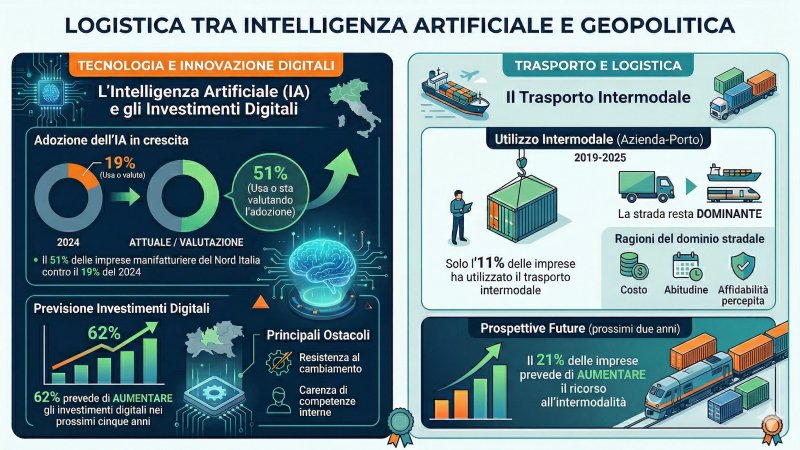








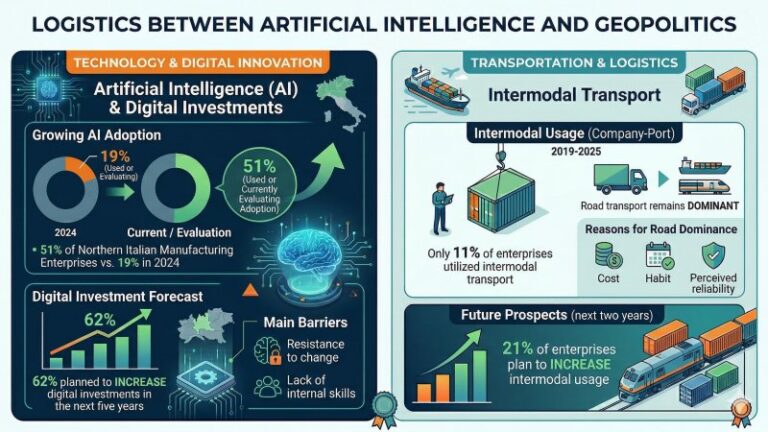
- Some 51% of manufacturing companies in northern Italy are using or considering adopting artificial intelligence, up from 19% in 2024. Meanwhile, 62% plan to increase digital investment over the next five years, although resistance to change and a shortage of in-house skills remain the main obstacles.
- Only 11% of companies used intermodal transport between their facilities and ports in the 2019–2025 period. Road haulage remains dominant due to cost, habit and perceived reliability, although 21% of firms expect to increase their use of intermodality over the next two years.
- Geopolitical tensions are affecting logistics operations for 43% of companies. Among firms exporting containers to the United States, 52% reported a decline in exports due to American protectionist policies.
The findings were presented in Milan on 25 March 2026 during the eighth edition of the survey “Corridoi ed efficienza logistica dei territori” (Corridors and logistics efficiency of territories), conducted by Contship Italia and Srm (Studi e Ricerche per il Mezzogiorno, a research centre linked to Gruppo Intesa Sanpaolo). The survey covered 400 manufacturing companies in Lombardy, Veneto and Emilia-Romagna—regions accounting for around 41% of Italy’s GDP and 51% of national import-export activity—and, for the second consecutive year, included input from 100 logistics operators. The results were presented at the second Contship Logistics Forum, which brought together more than 120 participants and 20 panellists from institutions, supply chain operators and commercial stakeholders.
The study examines three major themes reshaping logistics and global supply chains: the adoption of artificial intelligence and digitalisation, intermodality, and the impact of geopolitics. In a context marked by tensions in the Middle East and instability along Europe-Asia corridors, these issues are no longer limited to operational efficiency but have become levers of systemic competitiveness for the country.
On digitalisation, the picture is one of an accelerating manufacturing sector. Some 53% of companies report a high or very high level of digitalisation. Around 67% invest between 1% and 5% of turnover in digital technologies, while 28% exceed the 5% threshold. A total of 62% plan to increase investment over the next five years. The main constraints remain resistance to change, cited by 35% of firms, limited budgets (31%) and a shortage of internal skills (31%).
Artificial intelligence is seeing significant growth. Around 51% of companies are already using it or evaluating its adoption—up from 19% in the 2024 edition of the survey—and 68% expect to maintain or increase investment in the field. Among the most widely used technologies are Supply Chain Risk Intelligence, adopted by 32% of firms, blockchain (28%) and generative artificial intelligence for customer support (23%). Adoption of all the technologies analysed is expected to rise further over the next three years.
A similar trend emerges among logistics companies. Some 48% are already exploring or implementing AI solutions, while 66% plan to increase investment. Among operators, 55% believe artificial intelligence will improve performance, 59% expect cost reductions and 65% see it as a driver for the development of intermodality.
Intermodality remains the most critical issue. Between 2019 and 2025, only 11% of manufacturing companies used intermodal transport between their sites and ports on average. The preference for road haulage is mainly driven by lower costs, cited by 43% of firms, established habits (35%) and greater perceived reliability (31%). However, signs of change are emerging, with 21% of companies planning to increase their use of intermodality over the next two years. Logistics operators show higher uptake of combined transport than manufacturers: 23% report using it, and among these, 58% use it for between 20% and 60% of transported goods. A further 24% are considering increasing their use over the next two years.
The Forum also presented the results of a study on key full-load international corridors between Italy, Benelux, Germany and the United Kingdom, showing that on some routes intermodal solutions can be competitive with road-only transport. Participants shared a vision of an integrated system in which trucks and trains are not in competition but complementary elements of a more efficient logistics chain.
Geopolitical tensions are confirmed as a structural factor in corporate strategies. Some 43% of companies involved in the survey reported impacts on their logistics due to international conflicts and trade tensions, which are reshaping routes and sourcing strategies. A notable case concerns US protectionist policies: among companies exporting containers to that market, 52% reported a decline in exports. To respond to tariffs, firms are adopting different strategies: 39% are strengthening relationships with US customers, 24% are considering localising production in the United States or in countries with favourable trade agreements, and 23% are focusing on improving production efficiency to contain costs.
Europe remains the main export destination by sea, cited by 46% of companies, followed by North America (37%) and the Far East (15%). Among individual markets, the United States leads with 34%, ahead of the United Kingdom (24%) and China (12%). Genoa remains the most used export port, followed by Ravenna, Venice and La Spezia. On the import side, Asia maintains a dominant position, with the Far East cited by 62% of companies and China by 58%.
The Forum also hosted the preview launch of Synlog Alliance, the first data consortium dedicated to logistics and ports in Italy. The initiative aims to build a collaborative ecosystem based on advanced algorithms and shared standards, supporting strategic and operational decision-making through continuous data exchange across logistics, ports and transport.
Antonio Illariuzzi