







In 2024 Italian logistics accelerated at a pace not seen for a decade, and the gauge of this transformation comes from Mediobanca’s Research Department. The report Le Principali Società Italiane 2025, now in its sixtieth edition, examines 2,828 financial statements for the 2024 financial year and places the transport, forwarding and logistics supply chain among the pillars of the national economy, with companies that in scale, profitability and employment are approaching the large energy and manufacturing groups.
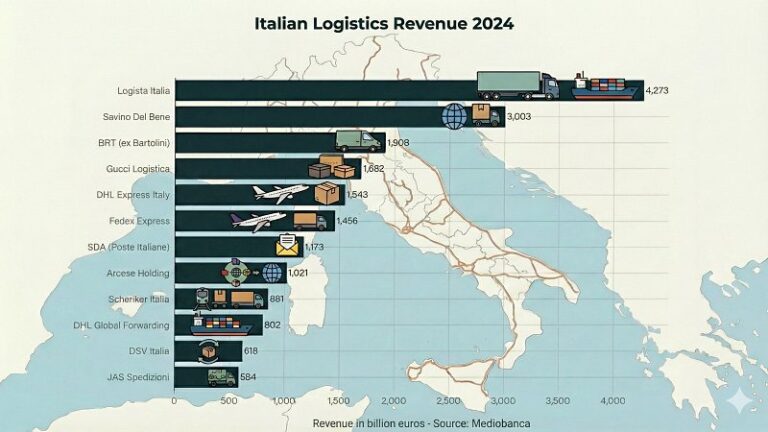
Within the overall ranking, Logista Italia leads the transport and logistics table with revenues of €4.273 billion and fiftieth place overall. The company, controlled by the Spanish group of the same name, operates in advanced distribution for tobacco, pharmaceuticals and fast-moving consumer goods. According to Mediobanca, it generates €169 million in added value and €120 million in net operating margin, with a workforce of 505 employees. Its structure, based on highly digitalised processes and high capital intensity, confirms that distribution has become a complex industrial activity, no longer confined to mere transport.
Savino Del Bene follows with €3.003 billion and consolidates the scale achieved by a forwarding company that uses intercontinental air and sea links as a platform for an integrated logistics model. Mediobanca records €566 million in added value, €160 million in net operating margin and a workforce that has grown to 6,115 employees. Its inclusion among the world’s major third-party logistics providers, with 2024 revenues of US$3.12 billion (around €2.9 billion), reinforces the Group’s international profile.
Third place goes to Brt, reflecting the impact of competition in the e-commerce delivery segment. Revenues fall to €1.908 billion from €1.986 billion, added value decreases to €126 million and the net operating margin turns negative at €47.4 million, while staff numbers drop to 3,056. The performance suggests a phase of reorganisation in response to shifting volumes and growing price pressure in domestic parcel delivery.
Just below the podium, Mediobanca highlights a close comparison among international express couriers. Dhl Express Italy closes 2024 with €1.543 billion in revenues, €310 million in added value and €66.2 million in net operating margin, with more than 3,800 employees. FedEx Express remains stable at €1.456 billion but sees its net operating margin fall from €40.46 million to €29 million, with a workforce of 4,497. Sda, the courier of Poste Italiane, rises to €1.173 billion, while operating profitability declines to €20.2 million.
Arcese Holding exceeds the €1 billion threshold with €1.021 billion, but its net operating margin shrinks to €1.2 million from €32 million in 2023. Staff numbers increase to 3,620, while industrial costs surge, weighing on its ability to generate income. In international forwarding, trends appear more closely linked to global trade flows. Schenker Italia reaches €850.87 million in revenues but sees its net operating margin fall from €36.4 million to €25.9 million, alongside a slight reduction in its workforce.
Dhl Global Forwarding stands at €802 million with a net operating margin that rises to €44 million, supported by stronger productivity. Jas, with €584 million in revenue, records one of the fastest growth rates in the sector: added value increases to €63 million and staff to 746, although the net operating margin of €13.6 million reflects the expansion phase of its network. At macro level, the Ferrovie dello Stato Group retains a central role, ranking seventh overall with €15.8 billion and more than 96,000 employees. Although not a pure third-party logistics provider, its extensive infrastructure shapes the competitive capacity of the national supply chain, especially in intermodality and the management of major rail hubs.