




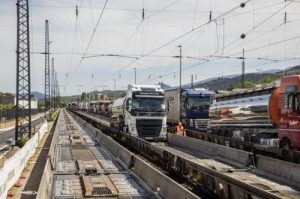
The rolling motorway between Novara and Freiburg had been scheduled to cease operations on 12 December 2025, but the general strike planned for that day has brought forward the departure of the last train by twenty-four hours. In fact, even the date of 12 December was three years earlier than the timetable originally set by Ralpin and the Swiss Federal Office of Transport, which pointed to 2028. This acceleration stems from a combination of operational challenges and rising costs.
Difficulties emerged from a surge in unplanned engineering works on the German Rhine rail corridor, which resulted in the cancellation of 10% of trains in 2024 and up to 20% in the first quarter of 2025. This drop in reliability undermined punctuality, a critical factor for transport operators managing tightly scheduled flows. In 2024 Ralpin also reported a loss of 2.2 million Swiss francs, a result linked to the additional costs generated by disruptions and the consequent reduction in available capacity. The Swiss Confederation assessed that extending the service until 2028 would require higher public contributions incompatible with the transitional role assigned to the rolling motorway, whose original function has been overtaken by the full development of unaccompanied intermodal transport.
In the short term, it is likely that some heavy goods vehicles will return to the motorway network, while companies adjust their fleets and reorganise flows. However, the Swiss and Italian strategy aims to expand unaccompanied combined transport. Operators such as Hupac have already planned to increase capacity on transalpine routes, while the Confederation is maintaining incentives to support the purchase of cranable semi-trailers. This shift demands significant investment from road haulage companies but is regarded as the most efficient means of ensuring stable rail capacity and easing pressure on Alpine traffic. The effects of the closure should therefore be temporary, with flows gradually returning to intermodality as the network adapts.
For nearly twenty-five years, the Novara–Freiburg link has served as a transitional tool within Swiss transport policy. Relaunched in its current form on 11 July 2001, the service was designed to accompany the construction phase of the new railway infrastructure under the Alptransit programme. The model entailed loading the entire articulated lorry onto low-floor wagons, with drivers travelling in a dedicated coach where they could take rest periods. Operated by Ralpin, owned by Bls, Hupac and Ffs Cargo, the line has carried more than two million lorries in roughly a quarter of a century, easing heavy traffic over Alpine passes and contributing to the environmental objectives set by the Confederation. As combined transport has consolidated and base tunnels have become more widely available, the role of the rolling motorway has gradually diminished, culminating in today’s decision to bring forward its closure.