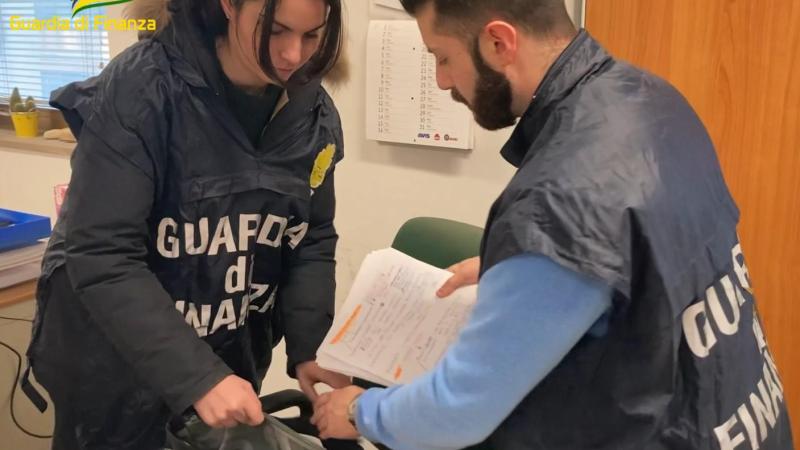


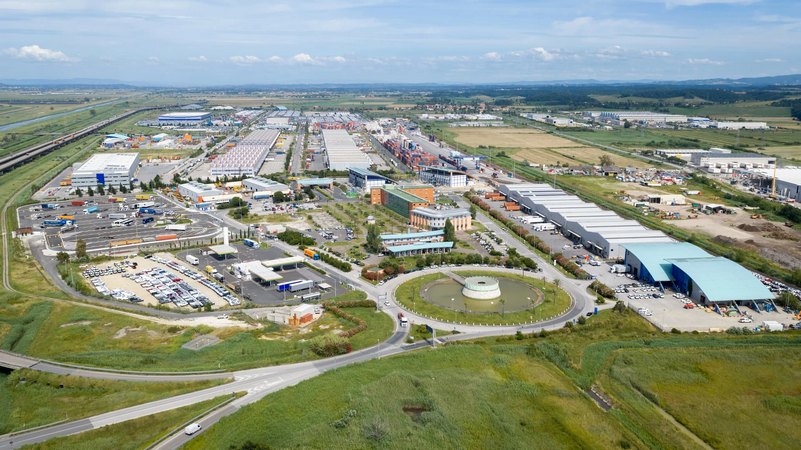






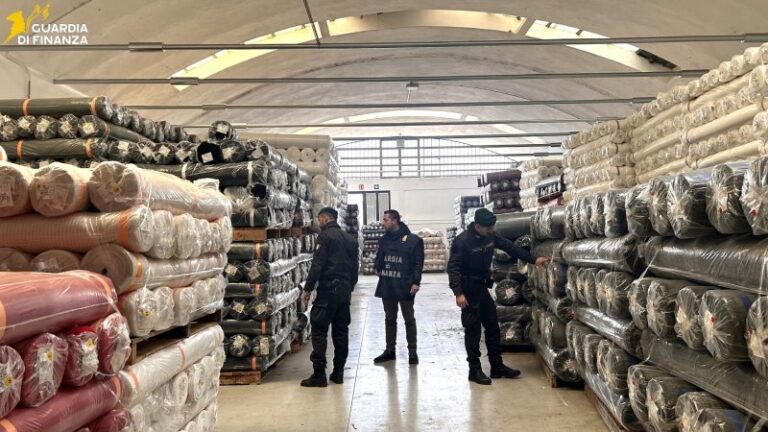
The Guardia di Finanza in Prato, under the coordination of the Procura Europea di Bologna (European Public Prosecutor’s Office, Bologna), has carried out a wide-ranging investigation into textile smuggling in the Prato industrial district, codenamed Fraus ab oriente. The operation led to the seizure of more than 5.5 million linear metres of fabric and over 237,000 items of clothing. The goods, imported from China with total evasion of customs duties and VAT, were destined for warehouses in the Macrolotti 1 and 2 area, one of the main logistics hubs of the local textile sector.
The investigation, launched more than a year ago, focused from the outset on the logistics dimension of the scheme. Officers intensified controls on road transport flows, stopping articulated lorries and curtain-sided trucks arriving from abroad and heading towards storage facilities in the Prato area. A systematic analysis of routes, arrival times and unloading methods made it possible to reconstruct the main entry corridors for the goods and to identify the accumulation and transhipment nodes used to conceal the illicit origin of the fabrics.
According to investigators, the system relied on a network of warehouses formally registered to different companies, often recently established and lacking any genuine commercial activity. These were so-called “open-and-close” firms used to justify the physical presence of the goods inside the industrial units, in a manner inconsistent with transport documents and the fiscal paperwork produced during inspections. Mapping local units that appeared vacant or leased to unrelated parties was one of the central elements of the inquiry.
Investigators believe that the logistics operation was orchestrated by a Chinese national resident in Prato, formally employed by a company active in fast fashion and wholesale textile trading. The suspect is alleged to have independently managed transport organisation, the selection of destination warehouses and the documentary triangulations required to simulate an intra-EU movement of goods. This was achieved by routing invoices through foreign companies, particularly in Poland and Germany, which were found to be non-existent or inactive.
The fabrics arrived from China with altered transport documents and, once in the Prato area, were rapidly unloaded and redistributed among several depots. The constant movement of goods, including during night-time hours, was intended to fragment stored quantities and reduce traceability to a single economic operator. In this context, warehouses were not merely storage sites but dynamic components of an opaque logistics chain designed to evade customs and tax controls.
Searches carried out at the end of October 2025 at warehouses, private homes and accounting offices confirmed the investigative framework. At that stage, more than 21,000 rolls of fabric were seized, equivalent to over 2.3 million metres, with evaded border duties amounting to nearly €1.3 million. IT devices and extra-accounting documentation useful for reconstructing the physical and administrative flows of goods were also confiscated. It also emerged that some industrial units, formally assigned to new legal entities, continued to be used as storage points by the same logistics network.
Surveillance and shadowing activities made it possible to intercept an attempted night-time transhipment of fabrics already illicitly imported and temporarily stored in warehouses registered to third parties. Checks carried out during unloading confirmed the true ownership of the goods and allowed the investigation to be extended to additional depots. Subsequent searches ordered by the Procura Europea resulted in the total seizure of more than 5.5 million metres of raw fabric, stacked on pallets with Chinese-language labels, as well as over 237,000 items of clothing. Overall, the operation removed more than 7.8 million metres of fabric from the illicit circuit, with a value exceeding €10 million and evaded border taxes, including customs duties and import VAT, amounting to almost €3.6 million.