






- On Wednesday 25 November, the Islamic Revolutionary Guard Corps Navy stated that two oil tankers had struck mines in the southern and eastern sectors of the Strait of Hormuz, causing fires in their engine rooms. This is the latest in a series of claims that began on 23 November, none of which identified the vessels or received independent confirmation.
- UKMTO bulletin 219-26, subsequently split into three separate notices, dates the attacks involving projectiles against three eastbound tankers to Sunday 22 November. Vanguard Tech identifies the vessels as VLCCs operated by South Korea's Sinokor. The JMIC considers Iranian claims about mines to be unverified.
- A NAVCENT notice issued on 18 November extends the US blockade of Iranian ports to vessels receiving cargo originating from Iran through ship-to-ship transfers at sea. Vessels bound for non-Iranian ports may transit the Strait, although they remain subject to boarding and inspection. Humanitarian shipments require prior authorisation.
Tensions in the Strait of Hormuz have been increasing week by week. Between 16 and 21 November, the Joint Maritime Information Center (JMIC) recorded seven attacks on oil tankers, bringing attacks on commercial shipping to their highest level since the war began. Since 23 November, the Islamic Revolutionary Guard Corps has claimed almost daily that additional vessels have struck mines while using routes Tehran describes as "unauthorised". On 18 November, the United States extended its blockade of Iranian ports to vessels receiving Iranian cargo through ship-to-ship transfers at sea, while on 24 November Iran's army commander, Amir Hatami, declared that the Strait would become "increasingly closed" until Tehran's conditions were met.
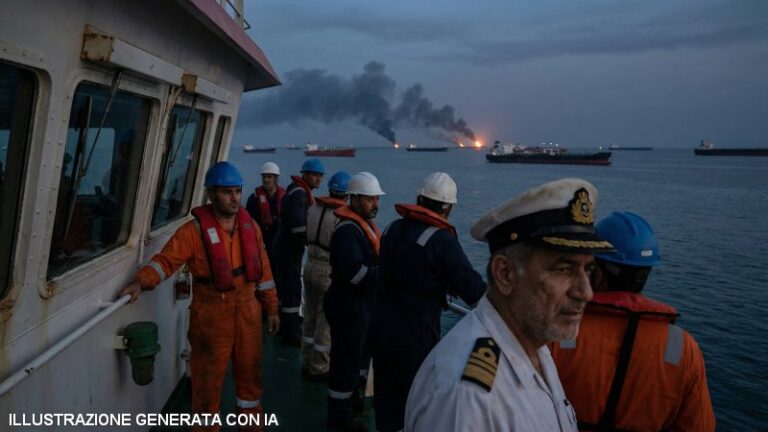
The latest Iranian announcement claims that two oil tankers struck mines in the southern and eastern sectors of the Strait of Hormuz in the early hours of Wednesday 25 November 2026, causing explosions and fires in their engine rooms. The claim was made by the Islamic Revolutionary Guard Corps Navy in a statement circulated by state media, which said the vessels were following a route "unauthorised" by Tehran. The statement provided no vessel names, flags or information about the crews, and no independent source has confirmed the incident. On the same day, army spokesman Mohammad Akraminia announced new surveillance systems and upgrades to existing equipment for monitoring the Strait, warning that vessels transiting without coordinating with Iranian forces faced greater risks.
The announcement follows a sequence that began on Monday 23 November, when the Tasnim news agency reported that two supertankers had struck mines, one north of Oman's Ghanam Island and the other in the eastern part of the Strait. That evening, Fars and IRNA carried another Revolutionary Guard statement claiming that three tankers were on fire, one in the southern sector and two to the east. According to Tehran, the vessels were sailing under US naval escort and air cover. On Tuesday 24 November, the Guards claimed that a "fourth tanker" had been struck and, later that evening, that a container ship had hit a mine north of Khasab, Oman, and come to a halt. IRNA accused the vessel of switching off its navigation and positioning systems. However, the Iranian authorities remain the only source for these reports. Without vessel identification details, it is impossible to rule out that several statements refer to the same ships or to establish a reliable total.
The Joint Maritime Information Center (JMIC) has not confirmed the Iranian claims about mines and records "projectiles of unknown origin" in its incident database. Between 16 and 21 November, it counted seven attacks on oil tankers in the Strait, bringing attacks on commercial shipping to their highest level since the war began in February 2026, following 18 confirmed attacks between 6 October and 1 November. The centre maintains its threat assessment for the Strait at "severe" and estimates that traffic is 65% below pre-war levels. In late October, US Central Command (CENTCOM) described Iranian reports about mines as "false", stating that American forces had cleared all recognised primary shipping routes. However, no denial has so far been issued in response to the announcements of 23–25 November.
Another source, UKMTO bulletin 219-26, separates the incidents reported on 24 November into three individual notices, recording strikes by "projectiles of unknown origin" at 20:25, 20:32 and 20:42 UTC on 22 November against eastbound vessels approaching the exit from the Strait near the Musandam Peninsula. According to the British maritime security agency, all three vessels continued their voyages and their crews were accounted for, while damage and environmental impact remain under assessment. The notices make no reference to mines and do not attribute responsibility. Maritime security company Vanguard Tech identifies the three vessels as Liberian-flagged VLCCs operated by South Korea's Sinokor, each with a deadweight capacity of approximately 300,000 tonnes: Bahrain Prosperity, built in 2012, and Cameroon Prosperity and Romania Prosperity, both built in 2007. According to Lloyd's List Intelligence data, Sinokor accounted for 47% of VLCC transits through Hormuz in September. On the afternoon of 22 November, a projectile reportedly struck the bulk carrier CTI Helen at anchor off Dibba, near Khor Fakkan, causing a fire but no casualties. Attacks on the tankers Captain Leon, Torkel and Arina, the latter two flying the Hong Kong flag, date back to Friday 20 and Saturday 21 November, according to the JMIC.
Tehran has made the restoration of normal shipping conditional on the lifting of the US naval blockade of Iranian ports and an end to the war "on all fronts". According to Reuters, Iran has proposed reopening the Strait within 48 hours of its conditions being accepted, through Qatari mediators. On Monday 23 November, Foreign Ministry spokesman Esmaeil Baqaei described the blockade as an act of military aggression, invoking the right of self-defence under Article 51 of the UN Charter and announcing the use of "all available means". On the same day, the US Treasury imposed sanctions on more than two dozen individuals, companies and currency exchange houses accused of belonging to Iran's parallel financial network, while Secretary of State Marco Rubio met Qatar's Prime Minister and Foreign Minister, Mohammed bin Abdulrahman Al Thani, in Washington. CENTCOM, meanwhile, has released figures indicating a recovery in oil shipments under US protection. On Tuesday 24 November, its spokesman Tim Hawkins stated that more than 108 million barrels of crude oil had passed through Hormuz under US protection during the previous week, the highest weekly volume since the conflict began. An anonymous US official quoted by CBS put the number of commercial transits since the 7 April ceasefire at more than 8,000, approximately half of them under US protection.
There are also conflicting accounts of the effectiveness of the US blockade. Donald Trump stated on 24 November that no Iranian vessel had managed to breach it, apart from the period when it was suspended during the summer. However, a report published the same day by United Against Nuclear Iran, an advocacy organisation supporting a hard line towards Tehran, counted approximately eleven small tankers carrying Iranian LPG and fuel oil that had crossed the blockade line since 14 July, along with at least 64 loading operations involving oil and petrochemical products during the same period, with laden tankers remaining off the Iranian coast. On Wednesday 25 November, First Vice-President Mohammad Reza Aref cited increased unloading and customs clearance of goods at the country's "non-southern" borders as evidence of Iran's ability to withstand the pressure, without providing volumes.
The blockade, imposed on 13 April and suspended in June following a draft agreement between Washington and Tehran, was reinstated by an announcement on 13 July and took effect at 20:00 UTC on 14 July. It covers the entire Iranian coastline, including ports and oil terminals, and applies to vessels travelling to or departing from Iranian ports regardless of flag, exposing them to interception, diversion and seizure. Neutral vessels bound for non-Iranian ports may transit Hormuz but remain subject to boarding and inspection to verify their cargo and intentions. US command separately asserts the right to board, search and seize vessels involved in transporting military contraband to Iran, with the possibility of capture outside neutral territory. Food, medicines and other goods essential to civilians may pass only with prior authorisation, which requires information on the vessel, owner, operator, ports, cargo, bill of lading and crew, including passport details. Inspection remains possible even after approval, and the authorisation does not permit the loading of additional cargo in Iran for the return voyage, apart from provisions and fuel.
The update issued on 18 November by NAVCENT-NCAGS through the JMIC and UKMTO extends the measures to ship-to-ship transfers at sea. A vessel receiving cargo originating from an Iranian port or coastline, transferred by a ship subject to the blockade, may also be considered to be circumventing the blockade, even if it has never entered Iranian waters or ports. The consequences listed range from detention and boarding to diversion and seizure, including an order to proceed to the Iranian port from which the cargo originated. For charterers and shippers, the actual origin of the cargo throughout the entire transfer chain therefore matters, not just the last port called by the vessel. The notice specifies that failure to comply immediately with instructions may rapidly lead to the use of force to disable or destroy the vessel. For the Gulf, Strait of Hormuz, Gulf of Oman and northern Arabian Sea, the document warns of further hostile activity, Iranian radio calls and inspections, possible attacks on vessels transmitting AIS signals and congestion at anchorages.
Antonio Illariuzzi