






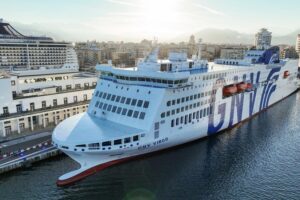

On 21 July 2025 in Haimen, located in China’s Jiangsu province, the christening ceremony of the Grande Shanghai took place. This vessel is the first in a new series of ten car carriers commissioned by the Grimaldi Group from the China Merchants Heavy Industries shipyard. These are next-generation ships designed for the transport of cars and trucks, with a loading capacity of 9,000 CEU for the first five vessels and 9,800 CEU for the remaining five.
The ship stands out for its technical innovations aimed at reducing fuel consumption and mitigating environmental impact. Grimaldi reports that, compared to previous models, the Grande Shanghai halves fuel consumption per transported unit. The project was developed in collaboration with the Danish naval architecture firm Knud E. Hansen. The vessel is 220 metres long and 38 metres wide, with a gross tonnage exceeding 93,000 tonnes and a top speed of 18 knots. Its fourteen decks can accommodate both electric and combustion-engine vehicles.
It is the first vessel in the group’s fleet to receive the Ammonia Ready classification from the Italian ship registry Rina, certifying its technical readiness for future use of ammonia as an alternative fuel. The ship has also earned several other certifications, including Green Plus, Green Star 3, Comfort Vibration and Comfort Noise Port, all related to emissions reduction, acoustic comfort and construction quality.
The vessel's technological equipment includes lithium batteries with a total capacity of 5 megawatt-hours, 2,500 square metres of solar panels and a shore power system, usable in ports that support such infrastructure. Energy management has been further enhanced with silicon-based hull coatings that reduce hydrodynamic resistance, as well as intelligent ventilation and air-conditioning systems.
The electronically controlled engine is equipped with exhaust gas treatment systems capable of significantly cutting sulphur oxides and particulate emissions. It also includes a selective catalytic reduction system to keep nitrogen oxide emissions within the Tier III regulatory limits. In addition, the ship features an air lubrication system, an optimised hull design and an innovative dual-blade side rudder, installed for the first time on this type of vessel, which improves propulsion efficiency and manoeuvrability.