


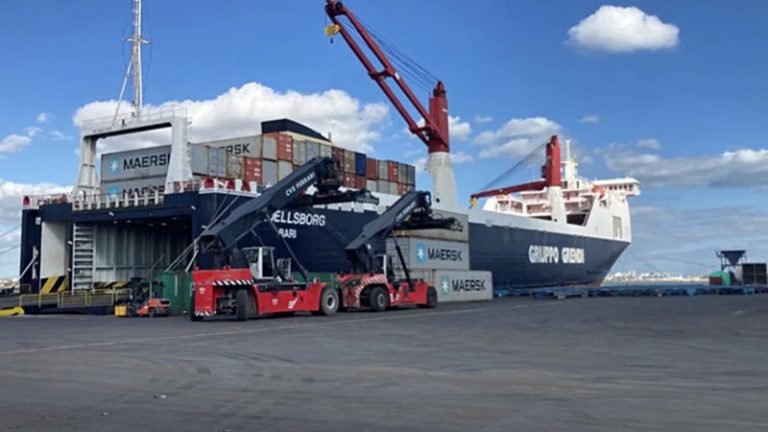
The maritime link between Tunisia and Italy operated by Grendi in partnership with Maersk has, since early December 2025, been extended further into the Peninsula. The service now functions as a container route connecting the Tunisian port of Rades with Cagliari, from where cargo units can proceed to Tuscany on Grendi’s domestic lines to Marina di Carrara. The commercial extension enables Maersk to offer a regular connection between Tunisia and mainland Italy using the Genova–Marina di Carrara–Cagliari–Tunis rotation, with Cagliari acting as the transit and integration point. The deployed vessel channels containers from Tunisia to the Sardinian port, where the Mito terminal aligns arrivals from North Africa with departures to the Peninsula.
The service retains its weekly frequency from Rades, departing on Friday evening and reaching Cagliari on Saturday, while the Cagliari–Marina di Carrara leg slots into the five weekly sailings of Grendi’s domestic services. Synergy between Maersk’s international network and Grendi’s domestic network creates an operational corridor linking Tunisia with Tuscany, from which containers can move on by rail or road to Italy’s main industrial districts.
For freight forwarders, the current structure has three operational implications. The first concerns transit times, which are reduced compared with alternative Mediterranean hub solutions thanks to the scheduled berth and continuous activity at the Mito terminal. The second is the ability to manage containers and ro-ro cargo through a single operating carrier, with harmonised procedures between Grendi and Maersk. The third is greater reliability, supported by the regularity of domestic departures and Grendi’s guaranteed dedicated berth in Cagliari. The overall system is therefore well suited to industrial flows, e-commerce supply chains and agri-food traffic requiring continuity and predictable lead times.
The development of the current route stems from a sequence of phases initiated in 2018. With ProCargo Line, the Grendi group introduced a link between Cagliari and the Tunisian ports of Sousse, Sfax and Zarzis, deploying the vessel Altinia for both ro-ro and container cargo. The project aimed to establish a corridor between Tuscany, Sardinia and Tunisia, leveraging Grendi’s regular lines between Cagliari and Marina di Carrara. The initiative was later suspended but remained a reference point for subsequent developments.
The service was relaunched in November 2023, when Maersk introduced a weekly ro-ro container connection between Rades and Cagliari, operated by Grendi. The rotation enabled Tunisian flows to be realigned with Maersk’s Mediterranean network, including routings via Tangier, and with Grendi’s services to the Peninsula. Integration into the Loro2 model transformed the Mito terminal into a hub capable of managing the rising container throughput, which increased from around 10,000 to 50,000 teu over 2023–2024, supported by progressively intensified links with Algeria and Tunisia. Between 2024 and 2025 the service matured to exceed one hundred ro-ro rotations operated by Grendi on behalf of Maersk, signalling a consolidation of volumes.