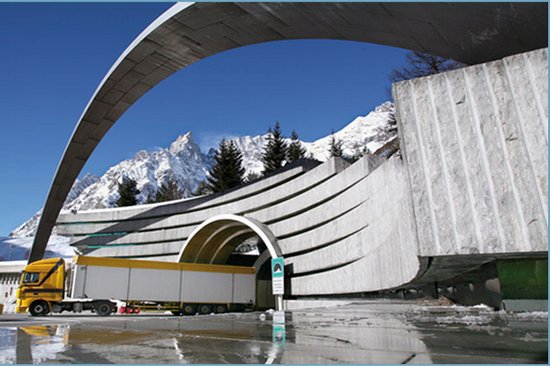







The Frejus road tunnel, which links Italy and France, effectively doubled its capacity on 28 July 2025 with the opening of a second tube to traffic. The €700 million investment enables smoother traffic flow, but above all enhances safety, as vehicles now travel in a single direction per tunnel, preventing head-on collisions. Furthermore, in the event of an incident that closes one tunnel, the other remains available for emergency evacuations, rescue operations and alternate-direction traffic.
Another major development is the new Centralised Control Centre, located at the tunnel entrance on the Italian side. This binational operations hub monitors both traffic flows (G1 from France to Italy and G2 in the opposite direction) and coordinates all the main safety systems, including ventilation, signage and alarm management. In the case of critical incidents, the centre ensures a swift response through real-time monitoring of all operational parameters within the tunnel.
On the evacuation front, the second tube includes 34 pedestrian shelters distributed along its entire length – 18 on the French side and 16 on the Italian – spaced every 350 to 400 metres. These shelters are interlinked between the two tubes, allowing for quick and protected exits in case of accidents or fires, directing users safely to the unaffected tunnel. Supporting the emergency services are nine vehicle-accessible cross-passages – five in Italy and four in France – allowing rescue vehicles to pass between the two tubes.
Tunnel operations are managed by six underground technical stations positioned along the route, ensuring uninterrupted functioning of all technological systems. Air quality in tunnel G2 is regulated by a longitudinal ventilation system, equipped with ceiling-mounted jet fans and two massive extraction units that can rapidly clear smoke and gases in case of fire, maintaining safe conditions for evacuation and the entry of emergency teams.
In terms of fire protection, each shelter and intermediate section of the tunnel is fitted with niches equipped with fire-fighting devices and smoke detection systems. This allows for the rapid identification of critical incidents and the prompt initiation of emergency response procedures.