








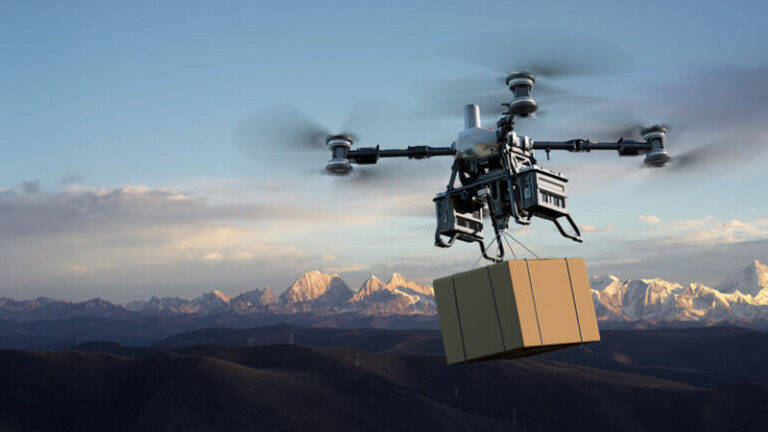
On 4 December 2025, the Chinese manufacturer Dji presented a new generation of cargo drones that increases the useful payload from the 30 kilograms of the previous FlyCart 30 to 85 kilograms. The new model, named FlyCart 100, aims to strengthen the company’s position in freight transport across sectors including emergency response, construction, infrastructure maintenance and supply chain operations. The FlyCart 100 uses the same four-axis, eight-propeller coaxial configuration as its predecessor but introduces a series of completely redesigned technical components.
The performance boost is also due to 62-inch carbon-fibre propellers paired with higher-torque motors and 420A electronic speed controllers. With dual batteries, the drone can carry up to 65 kilograms over 12 kilometres, while the emergency single-battery setup allows it to transport 80 kilograms over six kilometres. Its no-load endurance reaches 26 kilometres, with a maximum thrust of 82 kilograms per individual axis.
Its power system is based on 41Ah DB2160 smart batteries, compatible with ultra-fast charging via the C12000 charger or the D14000iE generator, enabling a full cycle in nine minutes. Hot-swapping allows battery replacement without interrupting operations, while the Battery Incubator maintains stable performance in low temperatures. The drone operates between –20°C and 40°C, withstands winds up to 12 m/s and can fly at altitudes up to 6,000 metres. Dji states that the batteries are rated for 1,500 charging cycles.
The safety architecture integrates high-precision LiDar sensors processing 300,000 points per second to map terrain, full-coverage millimetre-wave radar and a five-camera vision system with a colour low-light fpv camera. Additional lighting enables night operations, and an integrated parachute limits descent speed to 7 m/s in emergencies. The drone is certified IP55 for water and dust protection and uses intelligent functions such as AR detection of pedestrians and vehicles, load obstacle recognition and roll-free flight in crosswinds.
For loading and unloading, the FlyCart 100 introduces the flagship winch system, featuring a 30-metre cable with an electric hook offering automatic or manual release and a retraction speed of 1.2 m/s. The system includes wireless hook charging, real-time load weighing, a triaxial sensor for stabilising movement and emergency release. A simplified version with a 10-metre cable is available for the dual-battery configuration.
In terms of connectivity, the drone uses the O4 transmission system with a range of up to 20 kilometres and 4G support for operations in challenging environments, with an optional relay module. The Rc Plus 2 controller features a 7-inch screen with 1,400 cd/m² brightness and supports dual-operator mode. Accuracy with Ttk reaches ±10 centimetres horizontally and vertically.
The software ecosystem includes the Dji Delivery app for route planning, real-time control and operational management via the remote controller, with a-b route operation mode and AR visualisation. The DeliveryHub cloud platform centralises fleet management, mission analysis and transport supervision, with compatibility for kmz and kml files and mission continuity even in case of disconnection. The drone also supports third-party payloads via psdk.
Dji notes that its civil solutions are already used internationally for emergency, construction and logistics operations, including the transport of oxygen cylinders at high altitude (even on Everest) and the delivery of supplies after flooding. The FlyCart 100 is designed to broaden the scope of professional aerial transport and is available through authorised Dji Delivery dealers, with indicative prices of around 12,400–12,500 dollars (about 11,400–11,500 euros). The extended kit including the charging station is priced at about 16,700 dollars (around 15,300 euros).