



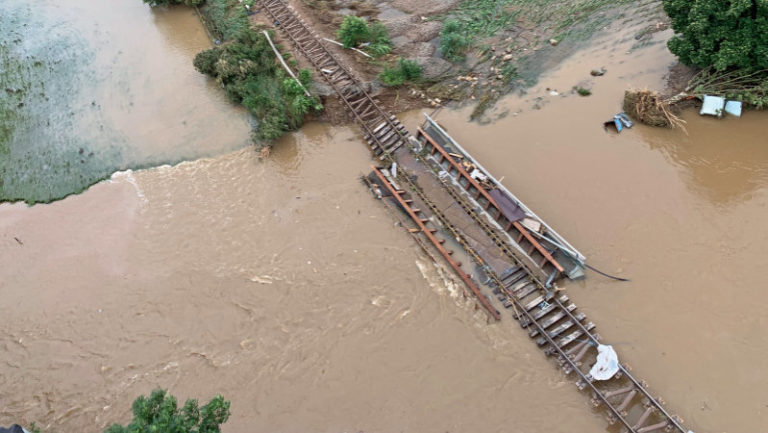
Storms, snowfalls, floods, fires, and high temperatures severely test the resilience of railway networks. Even a single delay can trigger a cascade of disruptions and service failures. Trains run on predetermined paths, designed to effectively manage infrastructure use and ensure safety. However, when a train loses its assigned track, the entire schedule falters, causing significant traffic slowdowns. In such scenarios, passenger trains are prioritized over freight trains, which often remain stationary for 24 hours or more, resuming with the next available slot and causing the subsequent train to be canceled.
In the intermodal sector, even minor delays can lead to cancellations and increases in transit time, difficult to explain to clients who may eventually switch to road transport. In Austria alone, according to the Austrian newspaper Kronen Zeitung, 1,900 trains were forced to stop in 2023 due to weather conditions, resulting in delays and cancellations in both passenger and freight traffic.
"In recent years, we have never had so many train cancellations due to storms as we did last August," stated Bernhard Rieder, spokesperson for the Austrian railways ÖBB, to the Austrian press. "Floods in Tyrol and Salzburg, and massive mudslides after storms caused 716 unscheduled stops due to bad weather. Additionally, rising temperatures in the Alpine region are leading to an increase in wildfires and landslides, distorting the tracks. We are monitoring the situation with great concern."
The issue has also been addressed by the British newspaper Financial Times, which, through interviews with government advisors and railway representatives, highlighted how heavy rains, sudden floods, and increasingly frequent landslides have seriously challenged the railway sector. Network Rail, the company that owns and manages most of the UK's railway infrastructure, added a message on its website warning that "more frequent and extreme weather conditions caused by climate change will impact our ability to operate the railway safely and punctually."
Heatwaves and rising temperatures also cause widespread train cancellations due to issues such as rail deformation and the collapse of power lines. Railway tracks are designed to withstand a certain temperature range but can warp in extreme heat, while the heat can also cause failures and blackouts on the lines.
To mitigate this phenomenon, Austria is modernizing its infrastructure to protect power lines from overheating, and tracks are now painted white to increase heat resistance. In the UK, more has been spent on drainage, and technology has been introduced to remotely monitor rail temperatures. Additionally, following the death of three people in August 2020, when a train collided with a landslide in Aberdeenshire, Network Rail developed new software to predict sudden and torrential rains.
Network Rail has also announced the allocation of £2.8 billion (€3.2 billion) to adapt the UK's railway infrastructure to climate change between 2024 and 2029. The investment will cover the construction of thousands of kilometers of drainage channels and embankments, as well as the modernization of machinery and structures, often dating back to the Victorian era and thus considered outdated and more vulnerable to weather-related failures. Network Rail has also introduced specific training for key staff members, who, through a course at the meteorological academy, will learn to analyze weather forecasts and make better operational decisions.
Efforts to reduce the impact of climate change on railway transport seem to be limited to disconnected local initiatives, and the European network, which should be the backbone of the Green Deal, appears at the mercy of increasingly frequent extreme weather events. The recent floods in Northern Italy, which paralyzed trains for several days, are a clear example of the powerlessness of an entire sector in the face of weather events that are now becoming commonplace.
Marco Martinelli