


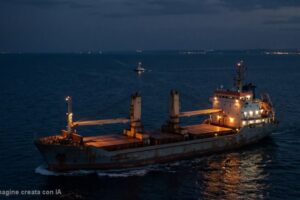

At 16:35 local time on 23 June 2025, the car carrier Morning Midas sank in international waters of the northern Pacific due to the fire that began on 3 June. This was reported by rescuers from Resolve Marine, who specified that the sinking occurred in waters five thousand metres deep and 360 nautical miles from the nearest land. Along with the ship, the 3,048 vehicles it was carrying, 350 tonnes of diesel, and 1,530 tonnes of low-sulphur fuel oil also sank. Given the sea depth, any recovery operation will be extremely difficult. As a precaution, two salvage tugs equipped with pollution control gear remained at the scene.
Nearly three weeks of attempts to keep the vessel afloat and tow it to port proved insufficient, hindered further by adverse weather conditions. The Morning Midas was launched in 2006. Measuring 183 metres in length and with a gross tonnage of 46,800, the vessel was managed by London-based Zodiac Maritime and flew the Liberian flag on behalf of China’s Saic Anji Logistics to transport vehicles from China to Mexico.
On 26 May 2025, the Morning Midas departed from the port of Yantai, China, bound for Lázaro Cárdenas, Mexico, where it was due to arrive on 15 June. Of the 3,048 vehicles loaded into its garages, 70 were fully electric and 681 were hybrids. At 14:00 local time on 3 June, the crew spotted smoke coming from one of the decks where the electric vehicles were stored, as the ship sailed roughly 300 nautical miles southwest of Adak Island, Alaska.
The crew immediately initiated emergency fire response procedures and deployed the vessel’s fire suppression systems. According to initial accounts, the ship’s CO2 suppression system was activated, but the blaze proved especially resilient, reigniting after the system was depleted, a behaviour typical of fires involving lithium-ion batteries, which are notoriously difficult to extinguish. Despite the crew’s efforts, the fire became uncontrollable, forcing the captain to order the abandonment of the ship.
The US Coast Guard promptly issued an Urgent Marine Information Broadcast, which was answered by three nearby merchant ships. At the same time, a C-130J Super Hercules aircraft was dispatched from the Coast Guard station in Kodiak, along with an MH-60T Jayhawk helicopter. All 22 crew members managed to evacuate using a lifeboat and were later rescued by the crew of the container ship Cosco Hellas. No injuries were reported among the seafarers.
After the evacuation, the Morning Midas was left adrift and ablaze in the North Pacific, with the fire continuing to spread across the vehicle decks. Zodiac Maritime, in coordination with the US Coast Guard, enlisted the salvage firm Resolve Marine to lead the rescue and firefighting efforts. The first tug, Gretchen Dunlap, departed Dutch Harbor on 6 June carrying salvage specialists and specialised equipment and reached the Morning Midas on 9 June. Due to the remote location of the incident, the tug took nearly six days to reach the drifting vessel.
On 11 June, salvage specialists aboard the Gretchen Dunlap managed to secure a tow line to the Morning Midas to stabilise its position and control its movement. However, they were limited in what they could do because of the intensity of the fire and the toxic fumes it generated. On 15 June, a second specialist tug, the Garth Foss, arrived on the scene, equipped with advanced firefighting capabilities. According to a statement from Zodiac Maritime, firefighting specialists aboard the Garth Foss assessed the condition of the Morning Midas and reported that both thermal scans and visual inspections showed no signs of active fire on board. The tow line was then transferred to the Garth Foss to maintain control of the ship’s drift while awaiting a third tug with long-range towing capacity.
Despite the initial positive signs following the arrival of the Garth Foss, aerial images from Coast Guard flyovers revealed the extent of the fire damage, which had spread across multiple car decks and visibly affected the hull. The structural damage to the ship was severe, with fire having run the entire length of the vessel from bow to stern and from top to bottom.
The rescue operation was further complicated by adverse weather, including winds of 45–50 knots and waves of approximately 1.8 metres. Maritime experts warned that rough weather could be a decisive factor in the fate of the damaged vessel, noting that burned-out components inside the ship might shift, causing instability and ultimately leading to the sinking of the car carrier. That event occurred on 23 June.
The Morning Midas incident is not the first of its kind. In 2022, the Felicity Ace sank in the Atlantic Ocean following a fire that lasted nearly two weeks, resulting in the loss of some 4,000 luxury vehicles. More broadly, in the past decade, thirteen major fires have occurred aboard car carriers, resulting in two sinkings and six total losses. Three of these incidents claimed the lives of six seafarers and two dock workers.