





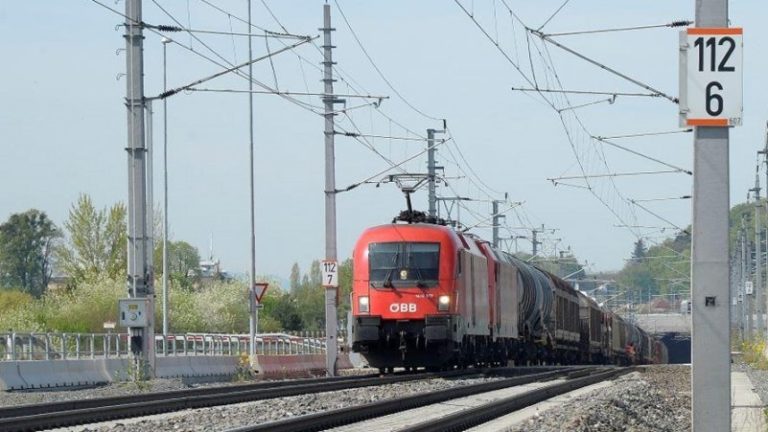
Environmental approvals do not slow down public infrastructure projects only in Italy. In Austria too, the bureaucratic steps required before tenders can be issued and construction sites opened are neither quick nor streamlined. The latest example is the Westbahn, the western railway line, a strategic corridor just over 300 kilometres long linking Vienna with Linz and Salzburg. While it represents around 10% of Austria’s rail network by length, it carries 30% of all train traffic.
In March 2026, after a lengthy procedure, one of the stages leading to approval of the four-track expansion of a section of this corridor was completed. The next steps involve detailed planning to move from design to construction. If everything proceeds as expected, work could begin between 2027 and 2028. The upgrade will affect a crucial section of the westernmost section between Linz and Salzburg, specifically the stretch crossing the Flachgau district between Köstendorf and Salzburg.
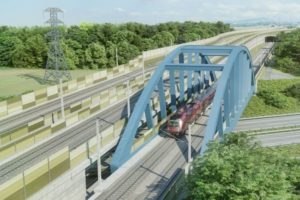
The new line will feature a double-track alignment and effectively serve as a four-track expansion of the existing railway. Despite its relatively short length of just under 22 kilometres, it includes a major engineering structure: a twin single-bore tunnel extending 16.2 kilometres. In addition to reducing journey times compared with the historic line, it will ensure greater transport capacity, improved operating conditions and no loading gauge restrictions.
The Westbahn has undergone significant upgrades in recent years. The line is now entirely four-track from Vienna to Linz, with some sections doubled alongside the historic railway and others replaced by high-capacity variants, largely in tunnels. Beyond Linz, upgrades have so far been implemented only in stages, including the section between Marchtrenk and Wels, the Gunskirchen–Lambach variant, which bypasses a long loop of the original line via a tunnel, and the Neukirchen variant.
The current project concerns the westernmost section from the Köstendorf junction to Kasern, on the outskirts of Salzburg. Work on the intermediate section between Attnang-Puchheim and the section now under upgrade remains to be defined. Austrian Federal Railways ÖBB (Austrian Federal Railways) has invested substantial resources in the Westbahn, albeit in phases, delivering complex works such as long tunnel variants and major node upgrades, including the four-track expansion of the entire Linz through station, where up to 450 trains pass every day.
The Linz–Wels hub represents Austria’s western node on the TEN-T Rhine–Danube corridor. The central section of the Westbahn also concentrates the country’s main logistics hubs: alongside Wels and Linz, there are freight yards at Sankt Peter, Sankt Valentin and Amstetten. The Wels terminal, a crossroads between Austria, Bavaria and the Czech Republic, is one of the most important freight facilities on the Austrian rail network. Notably, these volumes are currently handled with just four 580-metre tracks. However, the infrastructure is set for a significant upgrade, with major EU co-financed investments under way to extend track length to 700 metres and, above all, to create a direct link to Linz and Vienna. This will reduce shunting costs while increasing both capacity and operational efficiency.
Piermario Curti Sacchi