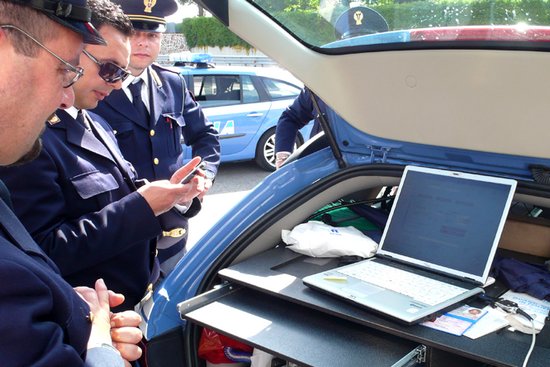





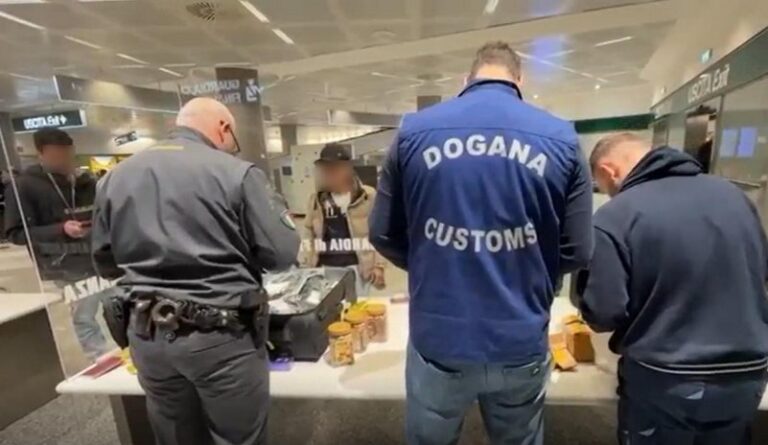
In 2025 Malpensa airport confirmed its role as one of Italy’s main entry points for illicit air-transport-related trafficking. From 1 January to 24 December, operations carried out by the Customs and Monopolies Agency and the Guardia di Finanza led to the seizure of large quantities of narcotics, contraband tobacco and illegal pharmaceutical products, intercepted both in passengers’ luggage and in postal consignments and freight traffic.
In recent months, particular attention has focused on medicines lacking health authorisation. On 17 December 2025, the seizure of more than 18,000 tablets and vials illegally introduced into the country was announced. According to the Customs Agency, the products were intended for treatments for erectile dysfunction, weight loss, aesthetic medicine and, in some cases, cancer therapies, with no guarantees regarding their composition or compliance with cold chain requirements. Checks resulted in eleven people being reported, with medicines found in personal luggage, postal parcels and packages carried by express couriers.
The December seizure forms part of a broader picture that had already seen, in September, the interception of consignments of dangerous healthcare products, including batches containing dichlorvos, an insecticide highly toxic to humans and subject to strict usage restrictions. According to the authorities, this is a growing phenomenon, also linked to the spread of e-commerce and the fragmentation of shipments, which makes irregular flows more difficult to detect.
Alongside this, throughout the year the Lombardy hub was at the centre of numerous anti-drug operations. At the start of 2025, an investigation launched between late 2024 and the early months of the year led to the arrest of nine traffickers and the seizure of around 120 kilograms of narcotics, including cocaine, heroin and tramadol, known for its use in armed conflict contexts. The drugs originated from African routes and were largely destined for northern Italy.
On 26 February, a 53-year-old Italian passenger of Tunisian origin was stopped on arrival at Malpensa with cocaine and hashish hidden in his luggage. In June, an operation developed between the airport and the Busto Arsizio area made it possible to seize 25 kilograms of drugs, disrupting a supply channel that used the hub as an entry or transit point.
One of the most significant investigative strands of the year emerged in autumn, with the so-called Punjab route. The arrest at Malpensa of a courier found in possession of 12 kilograms of heroin concealed in a hidden compartment triggered a wider investigation that led to the arrest of seven people, mainly of Pakistani nationality. The substance, originating from Pakistan, had an estimated market value of around one million euros and was intended for domestic distribution networks.
Alongside drug trafficking, 2025 also saw a significant resurgence in the smuggling of foreign manufactured tobacco. During the summer months, checks on flights arriving from North Africa and the Far East led to the seizure of more than 2,000 cartons of cigarettes, worth over 132,000 euros, with nine passengers reported. Between November and December, one of the highest peaks of the year was reached: 2,594 cartons of cigarettes, equivalent to around 26,000 packs, and 160 kilograms of shisha molasses were intercepted in checked baggage. The commercial value of the goods exceeded 165,000 euros, with substantial tax evasion. The operation led to nine passengers being reported and administrative penalties imposed on a further 254 travellers, totalling around 3.5 million euros.
During the year, control activities also covered currency movements. Between August and October, thanks to the use of specialised sniffer dog units, more than six million euros in undeclared cash were detected, attempted to be transferred illegally through the airport. While secondary compared with drug and goods seizures, the figure nonetheless confirms Malpensa’s role as a sensitive point for illicit flows linked to international mobility.
Antonio Illariuzzi