







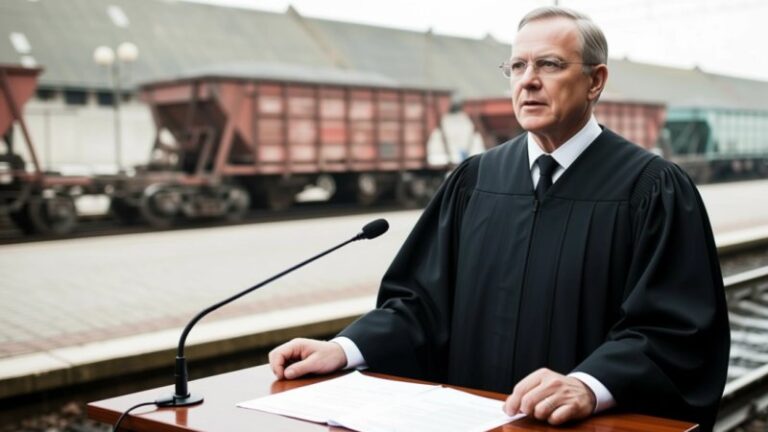
The Swiss Federal Administrative Court ordered on 24 November 2025 the provisional suspension of the decree through which the Federal Office of Transport introduced unilateral safety measures for freight wagons. The International Union of Wagon Keepers welcomed the decision, which it announced publicly. For now, it is a preliminary step that freezes the application of the requirements issued in September and revised in October, pending the outcome of the proceedings or a possible further ruling. For the association, the suspension confirms the need for measures grounded in data and applied consistently across the European rail area.
The regulatory process stems from the derailment of 10 August 2023 in the Gotthard Base Tunnel. The accident, which caused an estimated 150 million Swiss francs in damage and closed the tunnel for nearly thirteen months, prompted a detailed investigation. In its final report published in June 2025, the Swiss Transportation Safety Investigation Board identified a systematic risk of wheel failure on freight trains due to composite brake blocks and highlighted shortcomings in inspections and component traceability, despite compliance with existing standards.
In June 2025 SBB announced the gradual phase-out of wagons equipped with LL brake blocks by the end of the year, judging the likelihood of similar incidents to be high. The Federal Office of Transport intervened on 11 September 2025 with a decision introducing measures to be implemented immediately. These included increasing the minimum wheel diameter from 860 to 864 millimetres, more frequent inspections set after 50,000 or 200,000 kilometres, documentation of the most recent inspection, full visual checks including percussion tests, and operational guidance for drivers to prevent overheating. Implementation was to be completed by 31 December 2025.
The new rules provoked broad opposition. European industry associations, according to multiple sources, called the measures unilateral and overly burdensome. The International Union of Wagon Keepers invoked the interoperability principle under the EU–Switzerland agreement and contested the additional burden placed on wagon keepers. Swiss association Vap highlighted a sharp rise in costs for owners, while German associations viewed the measures as an obstacle to modal shift efforts in Austria, Germany and Italy.
Appeals were filed with the Federal Administrative Court by several major European operators, including Ermewa, Gatx and Vtg. The Federal Office of Transport had allowed appeals within thirty days, though without suspensive effect for most of the contested provisions unless otherwise decided by the court. Companies nevertheless had to prepare for compliance within the stated deadlines.
In October the Federal Office of Transport amended parts of the decree. Inspection criteria were linked exclusively to distance travelled and the deadline for completing technical checks was extended to the end of 2026, as formalised on 9 October. For the remaining measures, including minimum wheel diameter, percussion tests and operational instructions, the obligation to comply by the end of 2025 remained unchanged. The authority confirmed it did not intend to introduce further changes and reiterated its commitment to contributing to a shared solution, while defending its decision to act independently to ensure freight traffic safety.
Despite these changes, the International Union of Wagon Keepers continued to criticise what it describes as an uneven regulatory development, arguing that it creates uncertainty for operators and lacks a full impact assessment. The association calls for greater use of the European Union Agency for Railways’ Joint Network Secretariat as the forum in which to develop proportionate and harmonised measures. The suspension ordered by the Federal Administrative Court comes against this backdrop and opens the way for a broader debate as the sector awaits the new recommendations from the Joint Network Secretariat, expected by the end of the year. The decision offers all parties, including the Swiss authorities, an opportunity to move towards a shared European solution.