










- In 2025, cargo traffic at Italian airports increased by 1.7% to 1.271 million tonnes, following growth of 14.9% in 2024. In the first nine months of 2026, air cargo volumes fell by 0.9%: Malpensa recorded a 6.0% decline, while Bergamo grew by 56.3% and Naples by 18.8%. Malpensa and Fiumicino together handle more than 80% of the national total.
- Italian air cargo travels mainly on intercontinental routes: the European Union accounts for 26.2% of volumes, while the Middle East, Far East and North America together account for more than half. In the first quarter of 2026, Italy ranked sixth in Europe for cargo volumes, with Malpensa in eleventh place, while EU air cargo traffic increased by 5.6%.
- The 19 airport operators analysed ended 2025 with revenues of €3.452 billion (+4.7%) and net profit of €680 million (-3%). Several Italian operators outperform Amsterdam, Paris and Frankfurt in operating profitability, but revenue per aircraft movement remains significantly lower: €3,219 for Aeroporti di Roma compared with €4,905–5,953.
Following the sharp increase in 2024 (+14.9%), Italian air cargo growth slowed in 2025, ending the year at 1.271 million tonnes handled (+1.7%), before moving into a slight decline (-0.9%) in the first nine months of 2026. The figures come from a report commissioned by Anama and produced by the Fedespedi Research Centre, released in Milan on 24 November 2026. It examines the 2025 financial statements of Italy's 19 leading airport operators, which together handle 99.5% of national cargo traffic and 98.5% of passenger traffic, and compares them with those of the operators of Amsterdam, London Heathrow, Frankfurt and Paris.
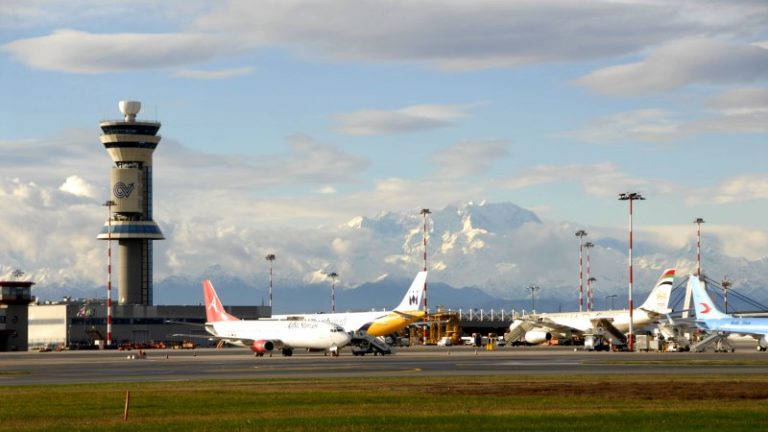
Activity remains concentrated at two airports, which together handle more than 80% of national traffic: Malpensa, which ended 2025 with 763,000 tonnes (+4.3%), and Fiumicino, with 274,000 tonnes (+0.8%). Malpensa, however, is driving the trend in 2026, following a 6% decline between January and September, only partly offset by growth at Bergamo (+56.3%) and Naples (+18.8%). Unlike passenger traffic, 82.6% of which is on European routes, air cargo flows are predominantly intercontinental: the EU27 accounts for 26.2% of volumes, while the Middle East (22.2%), Far East (18.4%) and North America (13.4%) together account for more than half.
In the European comparison, Italy ranked sixth for cargo volumes in the first quarter of 2026, while Malpensa ranked eleventh among the continent's airports. Over the same period, EU air cargo traffic increased by 5.6%, following a 2025 total of 15.1 million tonnes (+4.2%). Among European airports, including those outside the EU, Istanbul Airport ranked first for cargo in 2025, with 2.10 million tonnes, ahead of Frankfurt. Worldwide, air cargo traffic exceeded 69 million tonnes (+8.7%), supported by e-commerce, in a market considerably more concentrated than passenger aviation: the top 15 airports handle 64% of the total, led by Hong Kong (5.07 million tonnes), with Frankfurt, in fifteenth place, the only European airport in the ranking.
On the financial side, the 19 operators generated revenues of €3.452 billion in 2025 (+4.7%), including €2.236 billion from aeronautical activities and €1.216 billion from commercial activities such as retail, catering and parking, employing 12,438 people directly. EBIT rose to €1.091 billion (+8%), while net profit declined to €680 million (-3%), held back, according to the report, by financial expenses. Aeroporti di Roma (€1.175 billion in revenue and €273.1 million in profit) and Sea (€827.9 million in revenue and €190.5 million in profit) alone account for more than half of the sample's combined revenue and profits. The comparison with four major European airport operators favours the Italians in terms of operating profitability. In return on sales (ROS), Geasar Olbia (38.1%), Aeroporti di Roma (35.2%), Save (32.7%), Gesac (29.3%) and Sea (28.6%) outperform Amsterdam (25.7%), Paris (21.6%) and Frankfurt (19.2%), while Aeroporti di Roma (71.8%), Geasar (46%) and Sea (43.4%) stand out in return on equity (ROE). Aeroporti di Roma also has the highest debt ratio in the sample (10.5). The gap becomes apparent in unit revenues: per aircraft movement, Aeroporti di Roma and Sea generate €3,219 and €2,375 respectively, compared with €4,905–5,953 at the four foreign airports, a difference the report attributes to substantially higher traffic volumes and commercial demand. First-half 2026 financial results, already available for four operators, show revenue growth at Aeroporti di Roma (+4.3%, with net profit up 29.2%), Aeroporto di Bologna (+6.9%) and Toscana Aeroporti (+8.4%). Sea, by contrast, recorded a slight decline in revenue (-1.0%), with EBIT down 14.2% and net profit down 13.3%, during a six-month period in which its cargo traffic fell by 5.8%.
Paolo Maderna, president of Anama, points out that air cargo "accounts for a limited share of international trade volumes, but a very significant share of the value of our exports". In his view, airport operators' profitability provides "solid foundations" for improving efficiency, with the aim of making Italian air cargo "increasingly fast, predictable and connected" through investment in modern infrastructure, interoperable digitalisation and service quality.
Anna Maria Boidi