






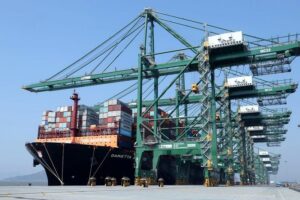

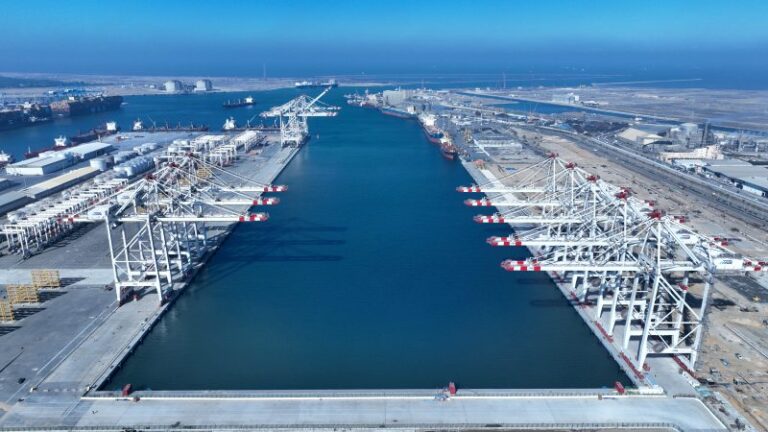
The European Commission has increased from two to four the number of non-EU transhipment ports classified as "neighbouring", meaning that calls by container ships at these ports do not count as ports of call under the ETS and FuelEU Maritime systems. Abu Qir and Damietta, both in Egypt, join East Port Said, also in Egypt, and Tanger Med in Morocco. The updated lists are set out in Implementing Regulations (EU) 2026/2562, for the ETS, and 2026/2563, for FuelEU, adopted on 19 November 2026 and published in the Official Journal of the EU on 20 November. The regulations will enter into force on 10 December 2026, the twentieth day following publication, and will affect shipping companies operating container ships.
The list is intended to reduce the risk of evasive port calls, as a shipping company could break up a voyage at a non-EU port close to the Union, shortening the leg subject to the ETS and shifting transhipment operations outside the EU. Calls by container ships at the four listed ports will therefore not count as ports of call when determining where a voyage subject to the ETS begins or ends. Instead, the calculation will be based on the previous qualifying port of call. The same principle applies to FuelEU Maritime and, according to the European Commission's Directorate-General for Mobility and Transport, energy consumed during the stop must be reported as energy used during the voyage. The rules do not prohibit transhipment or the use of the listed ports.
To qualify for inclusion on the list, a non-EU port must be located less than 300 nautical miles from an EU port and must have recorded a transhipment share exceeding 65% of its container traffic over the latest available twelve-month period. The country in which the port is located must also have no equivalent measures in place. The Commission concluded that Abu Qir and Damietta meet the distance and traffic-volume requirements and that Egypt does not apply measures equivalent to those of the EU. Draft versions of the two acts were published on 17 July 2026, with a consultation open until 14 August. The amendments received favourable opinions from the Climate Change Committee, for the ETS, and the Committee on Safe Seas and the Prevention of Pollution from Ships, for FuelEU.
The list is updated every two years, by 31 December. Maritime transport has been covered by the ETS since 2024, and shipping companies were required to surrender allowances covering 40% of their 2024 emissions in 2025 and 70% of their 2025 emissions in 2026. In 2027, they will have to surrender allowances covering the full amount of their 2026 emissions subject to the ETS. FuelEU Maritime has applied since 1 January 2025 and requires an initial 2% reduction in greenhouse gas intensity compared with the 2020 reference value, rising to 6% in 2030.
On 17 July 2026, the Commission proposed a reform to update the list annually and lower the transhipment threshold from 65% to 50% for ports within 300 nautical miles, which is currently under consideration by the European Parliament and the Council of the EU. The proposal also introduces an infrastructure-only criterion for ports within 150 nautical miles: a water depth exceeding 11 metres, berths longer than 250 metres and suitable quayside cranes. The World Shipping Council (WSC), which represents ocean carriers, has expressed concern about this criterion, arguing that ports with deep water, long berths and cranes could be included even without transhipment activity, affecting competition rather than emissions. The reform also provides for a reduction, until 2035, in the allowances to be surrendered for ships of at least 10,000 TEU arriving from non-EU ports on routes exceeding 300 nautical miles. The reduction would be proportional to the number of containers discharged at an EU port solely for transhipment to destinations outside the EU.
Mara Gambetta