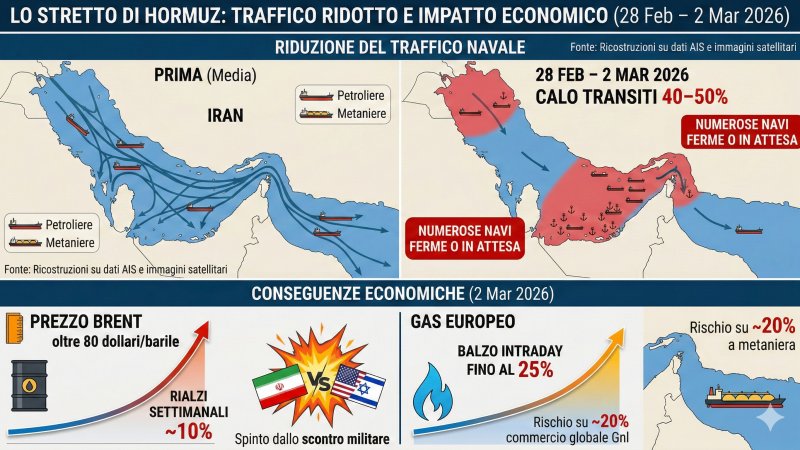





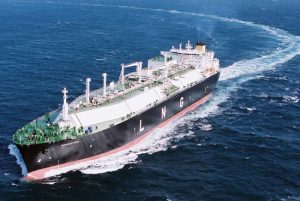
As of 9 March 2026, navigation through the Strait of Hormuz is still hindered by military activity and by reduced, if not entirely absent, insurance coverage for vessels. Some sources report that very few ships are transiting the strait and that most belong to countries considered friendly by Iran. Among the vessels blocked are those transporting natural gas, leading to reduced supplies to Europe and a rise in prices. On the morning of 9 March, the price reached €62 per MWh, according to Dutch TTF futures, the European benchmark.
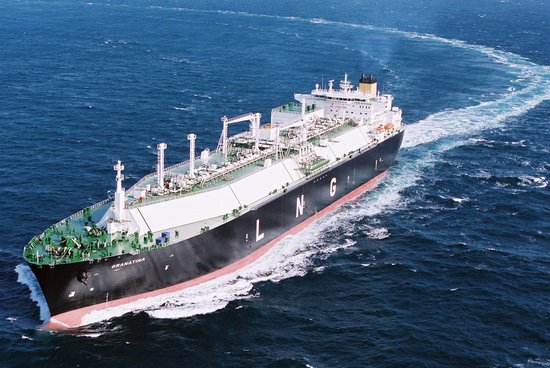
The effective blockage of Hormuz is also triggering another negative development for Europe: LNG carriers originally bound for European ports are being diverted to Asian destinations. This reflects intense competition between the two continents to secure cargoes already at sea. According to Reuters, by 9 March at least three LNG carriers — two loaded in the United States and one in Nigeria — that had been sailing towards Europe changed course in the Atlantic and headed towards Africa. Bloomberg reports that the number of diverted ships could be “several”.
The three vessels whose identities are known and which have turned their bows towards Asia are LNG carriers: Simsimha, loaded in the Gulf of Mexico for an unspecified port in northern Europe, changed course on 4 March; Clean Mistral, loaded at the US Corpus Christi terminal, also diverted towards Asia on 4 March; and BW Brussels, which loaded in Bonny, Nigeria, headed towards the Cape of Good Hope on 3 March.
The United States, Africa (both western and northern) and Central Asia are currently Europe’s main sources of liquefied natural gas supply after Qatar announced a suspension of production due to the war and Russia’s role has progressively diminished following the invasion of Ukraine, with the EU planning to phase out this source entirely by 2027. The situation is reopening debate over whether sanctions on Russia should be eased, potentially restoring access to this historic source of gas, as well as oil and diesel.
The European Commission insists that “we will not return to Russia”, but in Central Europe — particularly Germany, Austria, Hungary and Slovakia — some politicians and industry operators are discussing whether Russian supplies should be reopened, although the debate has so far only surfaced superficially in public discussion. One concrete outcome has already emerged in Hungary, which obtained a partial one-year exemption from Trump allowing the import of Russian oil and gas via the TurkStream gas pipeline and the Druzhba oil pipeline. This precedent could be used by other countries if Europe’s energy crisis continues in the coming weeks, with heavy repercussions for the continent’s logistics and industry.
M.L.