




During the night between Tuesday 20 and Wednesday 21 January 2026, in Krefeld, in the German Land of North Rhine-Westphalia, a semi-trailer loaded with electronic accessories for video games was stolen. The cargo of an estimated value of at least €1.5 million, disappeared while the articulated vehicle to which it was attached was parked on Promenadenweg, in the Oppum district. The shipment was destined for the Netherlands, with delivery scheduled for 21 January, and the disappearance of cargo was discovered by the driver at around 5.00 am, at the end of the overnight rest period.
The theft affected a German forwarding company whose name has not been disclosed. The stolen load included steering wheels and pedals for driving simulation, products with a high unit value and strong resale potential, a factor that makes this type of cargo particularly exposed. The Krefeld case appears to be a structured operation: detaching and removing an entire semi-trailer during the night requires an available tractor unit, technical expertise and very short intervention times, conditions generally associated with organised criminal groups rather than opportunistic theft.
Germany remains one of the European countries most affected by thefts involving heavy goods vehicles. In 2023, 2,498 incidents were reported, a level higher than that recorded in other major European countries, with estimated annual losses exceeding €1.3 billion. The phenomenon is also evolving in qualitative terms: the incidence of minor thefts is declining, while attention is increasingly focused on high-value, highly liquid cargoes, resulting in more severe impacts per individual incident.
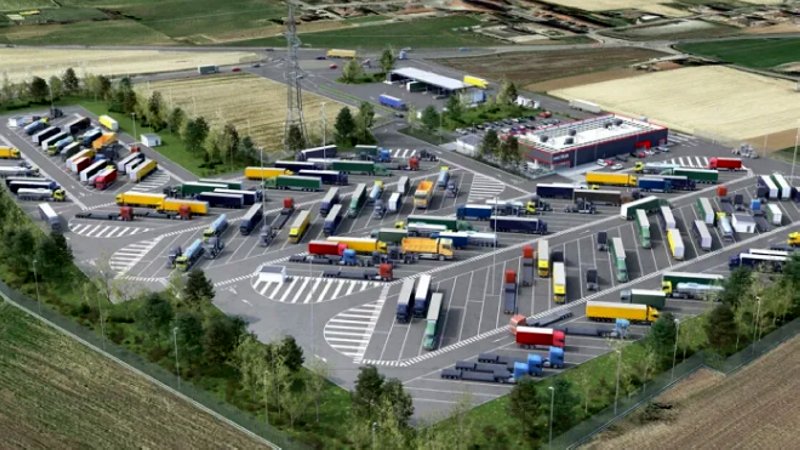
A significant part of the causes is infrastructural. The cargo was stolen during an overnight stop in an area reportedly lacking surveillance and the barriers typically found in protected parking areas. The shortage of secure parking remains a structural issue: against an estimated requirement of around 395,000 secure parking spaces in the European Union, only 4,943 are reported to meet certified standards. As a result, many stops take place in areas not designed to protect vehicles, drivers and cargo, with higher exposure during night-time hours, when driving and rest time regulations make the choice of stopping point less flexible.
This takes place in a context in which specialised criminal groups operate on a transnational basis, with the ability to target multiple objectives and move goods rapidly. Techniques include both physical intrusion and fraudulent practices exploiting the digital logistics ecosystem, with growing cases of social engineering and the use of tools to interfere with satellite tracking. The theft of an entire semi-trailer also reduces on-site intervention time and limits physical traces, making recovery more complex when there are no immediate leads regarding licence plates, support vehicles or exit routes.