



Helrom, the Frankfurt am Main-based rail operator specialising in the intermodal transport of semi-trailers using its proprietary horizontal loading technology, completed on 20 January 2026 the restructuring launched under the preliminary insolvency proceedings opened on 14 July 2025 by the Amtsgericht Frankfurt am Main (Frankfurt am Main Local Court). The process concluded with the entry of a new majority shareholder, Hrg, through the creation of Helrom Holding Limited, and with the involvement in the new structure of The Greenbrier Companies, Dal Deutsche Anlagen-Leasing and Société Générale, namely the wagon manufacturer and the main financiers that had supported the company’s expansion with total loans amounting to €67.4 million.
The crisis emerged as a short-term liquidity shortage, linked, according to CEO Roman Noack, to the absence of expected equity capital that did not arrive within the required timeframe. The turning point came six months after the opening of the proceedings: following the signing of a purchase agreement announced on 11 January 2026 and the creditors’ meeting held on 20 January 2026, the court made the plan binding, allowing operations to continue without interruption to key services. Management continuity remained a central element. Roman Noack retains his role as chief executive, while co-founder Keith Heller remains part of the governance of the new holding alongside Thomas W. Rissman and Albert Enste.
The Helrom case stands out because service disruption was not the dominant feature of the crisis. Day-to-day operations continued largely unchanged, and only one recently launched connection is reported to have been suspended during the most delicate phase. In parallel, in October 2025, during the proceedings, Helrom activated the Regensburg–Verona route via the Brenner corridor with four weekly departures in each direction, signalling a continued commercial presence on a corridor under pressure from road traffic restrictions and works on the Lueg Bridge along the A13 in Tyrol.
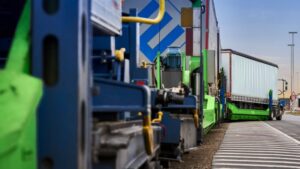
At the core of the industrial proposition remains Helrom Trailer Rail, a hydraulic side-loading system mounted on the wagon that enables the transfer of non-craneable semi-trailers without the need for complex terminal infrastructure. Operations take around two minutes per semi-trailer and approximately two hours to load or unload a full train, with infrastructure requirements limited to a flat, asphalted surface alongside the tracks. This feature, combined with compatibility with the standard semi-trailer fleet, has underpinned the company’s growth and the development of commercial relationships with industrial customers, including the dedicated service for Audi launched on 7 April 2024 between Regensburg and Lébény in Hungary, in collaboration with Duvenbeck and Bayernhafen. Each journey carries 36 semi-trailers and the pair of daily services removes 72 lorries per day from Monday to Friday, with an estimated saving of around 11,500 tonnes of CO₂ per year.
On the financial side, in February 2023 Helrom received a public grant of €15 million from the German Federal Ministry for Transport and Digital Affairs (Bundesministerium für Verkehr und Digitales) under a programme supporting innovation in rail freight transport. In June 2023 the company announced financing of €34.5 million, followed on 27 May 2025 by a second green loan of €32.9 million, both arranged with Dal and Société Générale and linked to the purchase of wagons and capacity expansion. The crisis, which broke out seven weeks after the announcement of the May loan, appeared to be a classic cash-flow issue in a capital-intensive model, where asset-backed financing covers rolling stock acquisition but does not always address the working capital required to sustain operational growth.
The industrial set-up explains why, despite crossing the financial warning threshold, the company was able to find a way out with a new investor. Helrom has developed an integrated model that includes wagon management, traction, terminal operations and planning, reducing interfaces along the operational chain while increasing commitments in terms of staff and organisational structure. The company employs around 250 people, with a presence in Hungary through Helrom Hungary Kft, and operates a terminal network across Germany, Austria, Hungary and Italy, with services from Düsseldorf to Vienna, Budapest, Verona and Trento, as well as along the Bavaria–Italy corridor via the Brenner.
P.R.