


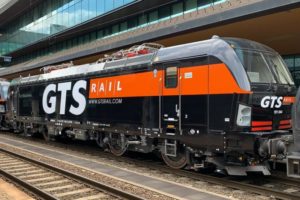
Gts Rail, the rail operator of the Gts Logistic group, activated a new intermodal freight rail connection between Interporto Padova and the port of Zeebrugge in mid-January 2026. Zeebrugge is part of the unified port system Port of Antwerp-Bruges. The service is designed to enhance logistics flows between north-eastern Italy and one of Northern Europe’s main maritime hubs, with a particular focus on traffic bound for the United Kingdom, Ireland and the Nordic region.
The service is operated directly by Gts Rail in cooperation with Terminal Interporto Padova and, in its start-up phase, provides for three weekly train services, with the aim of increasing to five weekly services by the second quarter of 2026. The connection accepts all main intermodal loading profiles, with the exception of SR/P400 gauge semi-trailers, and also allows customs operations to be carried out in Padua for goods destined for the United Kingdom.
The first service from Belgium to Italy ran on 15 January 2026, followed on 18 January by the first departure in the opposite direction. The launch comes at a time of major reorganisation of European intermodal corridors, marked by the closure of some long-standing solutions such as the rolling motorway between Novara and Freiburg and by the resulting need to expand unaccompanied rail freight capacity on north–south routes.
The new Padua–Zeebrugge service forms part of Gts Logistic’s strategy to develop integrated international road–rail–sea rail services designed to offer door-to-port solutions to Italian shippers. Within this framework, Interporto Padova acts as an advanced technical and customs platform for the north-east, while Zeebrugge serves as the gateway to short-sea maritime links to the British Isles and other North Sea routes.
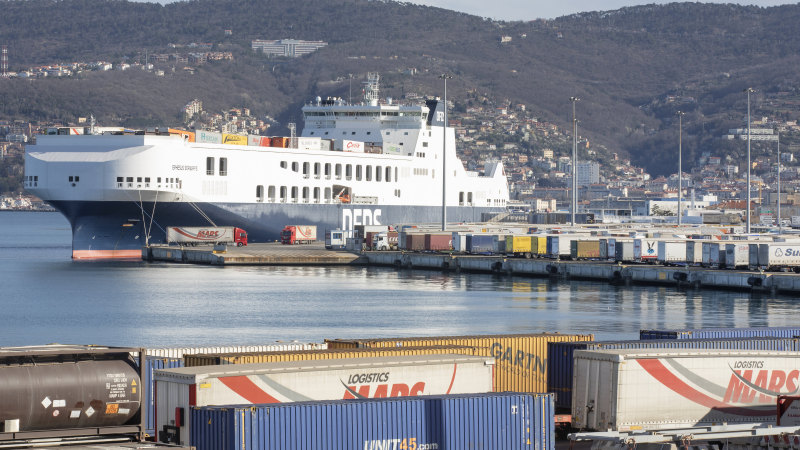
Zeebrugge is a central node in this strategy. The Belgian port is one of Europe’s leading hubs for container, ro-ro and automotive traffic and is the number one European port for maritime connections with the United Kingdom. Its strength lies in the combination of specialised maritime terminals and a dense network of rail connections with the continental hinterland, which in recent years has benefited from targeted investments to increase rail’s modal share.
The new Padua link is not an isolated initiative. Rather, it complements a range of rail services already in operation or recently launched from Italy to Zeebrugge, which together point to a gradual strengthening of Italy’s rail accessibility to the Belgian port. Historically, these services have captured container and ro-ro flows destined for the Benelux markets and, above all, the United Kingdom, leveraging Zeebrugge’s specialisation in post-Brexit short-sea shipping. The new routing via Padua broadens this catchment area by directly involving the productive and manufacturing heart of north-eastern Italy.
Alongside Gts, other rail and logistics operators are also investing in the Italy–Belgium axis, indirectly reinforcing Zeebrugge’s role as a reference port. This includes the new Liege–Domodossola intermodal connection launched in January 2026 by CargoBeamer, linking eastern Belgium with the Piedmont hub at the foot of the Alps with three weekly services, set to rise to six during 2026. Although it does not directly reach Zeebrugge, the service feeds into the same Belgian logistics system and, via the internal network, provides access to North Sea ports, including the Antwerp-Bruges complex.
Another element is the joint venture Modalink, set up by Lineas and Fs Logistix, which operates rail services between Antwerp and the Milan area. Here too, the stated aim is to strengthen one of Europe’s most important freight corridors by creating structured rail alternatives to all-road transport and increasing overall connectivity capacity between Italy and Belgium. Taken together, these initiatives point to a clear trend: the port of Zeebrugge, alongside Antwerp, is increasingly being used as a northern gateway for Italian goods destined for Northern European and UK markets. The ability to combine direct intermodal trains with frequent and reliable maritime services makes the system competitive compared with other port options, particularly at a time when post-Brexit customs formalities require well-equipped logistics nodes and established processes.
For Interporto Padova, the connection with Zeebrugge is also consistent with the infrastructure and industrial strengthening path pursued in recent years. The Veneto inland port has invested in gate automation, process digitalisation and the enhancement of rail services, and has recently awarded the management of the intermodal terminal to the Psa–Logtainer consortium, in a deal worth around €75 million. In this context, each new international connection helps to increase the attractiveness of the Padua hub within the European logistics system.
Anna Maria Boidi