







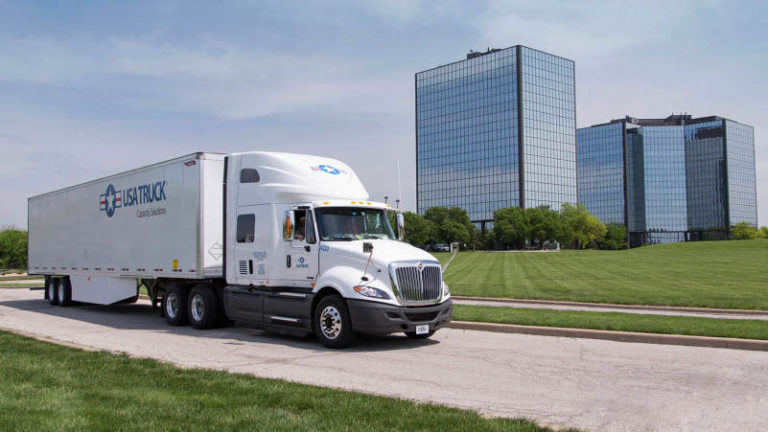
Just three years after the acquisition of the business by Schenker on 8 January 2026, the Danish logistics group DSV has announced the sale of the entire share capital of USA Truck and its subsidiaries to UTAC, an Arkansas-based entity. The transaction was finalised on 9 January and has returned one of the leading US road freight operators to American ownership, while the Danish Group remains in North American road haulage with its Road division. The financial terms of the deal have not been disclosed. According to DSV, the disposal forms part of a strategic decision, announced after the third-quarter 2025 results, to divest activities that are not aligned with its business model.
DSV inherited USA Truck from Schenker, which it acquired in 2025, and has now sold it to a vehicle controlled by the current and former management of the haulage company itself. At the helm of UTAC are three executives with deep knowledge of the acquired business. George Henry, the current chief executive of USA Truck, will continue to lead operations. Henry joined the group in 2018 and has overseen all its most recent phases, first under DB Schenker and then under DSV. Zachary King, who served as USA Truck’s chief financial officer until 2022, returns as interim CFO to manage the transition. James Reed, chief executive between 2016 and 2022 and the architect of the turnaround prior to the sale to DB Schenker, will provide strategic support as a consultant. The structure of the transaction follows a management buyout model, typically financed through a combination of management equity, debt and, in some cases, backing from financial investors.
The sale of USA Truck represents the third change of ownership in a relatively short period. In June 2022, DB Schenker acquired the company for around USD 435 million, paying USD 31.72 per share, a 118% premium over the market price. With the completion of DSV’s acquisition of DB Schenker in April 2025, USA Truck was brought into the Danish group’s perimeter. However, only a few months later DSV launched a strategic review of its US road operations. During the second-quarter 2025 results call, chief executive Jens Lund stated that road transport in the United States was generating significant losses and required a structural decision. In the third quarter of 2025, Schenker’s US road activities recorded a net loss of DKK 90 million, equivalent to around EUR 12 million.
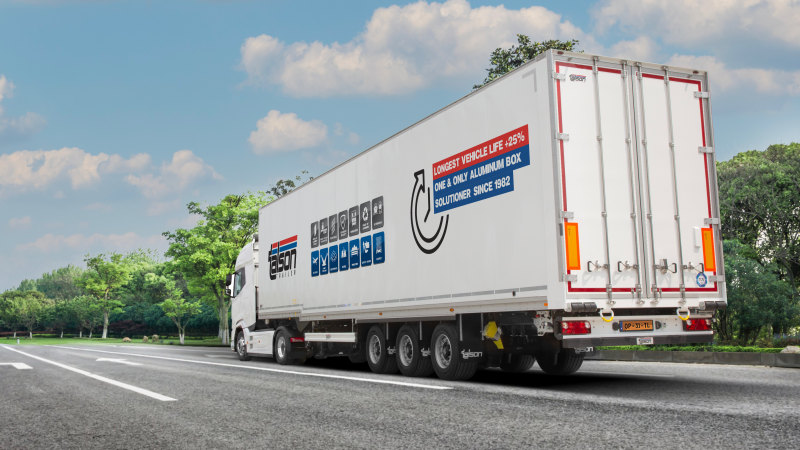
The main driver behind the divestment lies in the incompatibility between USA Truck’s asset-heavy model and DSV’s industrial approach. The US company operates a fleet of around 2,000 tractors and 6,500 trailers, with activity concentrated mainly in the eastern United States. This structure requires continuous investment in vehicles, maintenance and personnel, and exposes the operator to the cyclical nature of the road freight market. By contrast, DSV has built its growth on a low-capital-intensity model based on flow coordination and intermodality, and has made it clear that part of Schenker’s US road operations had been acquired with the intention of a subsequent resale.
From UTAC’s and its management’s perspective, the logic of the transaction is the opposite, allowing USA Truck to operate with greater decision-making autonomy and a sole focus on the US full truckload market, no longer as a peripheral asset within a large global group. The company is headquartered in Van Buren, Arkansas, where it was founded in 1983, and maintains a network of operational and driver support facilities across several Midwestern and Southern states. In recent years, under James Reed’s leadership, USA Truck had already demonstrated its ability to improve performance through selective fleet reductions, technology investment and a stronger focus on workforce stability. In 2021, net profit reached USD 24.8 million, more than five times the result of the previous year, before the negative market cycle and integration into large international groups once again squeezed earnings.
Market conditions are central to understanding the deal. Between 2022 and 2025, the US full truckload sector went through one of the longest downturns of recent decades, marked by overcapacity, pressure on freight rates and rising operating costs. This environment particularly affected operators with large owned fleets, making the sector less attractive to many financial investors. However, the reduction in fleets and the exit of numerous small carriers are now creating the conditions for a rebalancing of supply. Against this backdrop, USA Truck’s management is betting on a gradual recovery in volumes and rates over the course of 2026, seeking to leverage an existing asset base and an established customer portfolio.
M.L.