







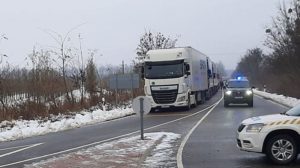
Following the demonstration held on 22 December 2025 in Budapest – attended, according to organisers, by between 1,500 and 2,000 trucks – the protest by Hungarian hauliers has entered a pause linked to the Christmas period. The main immediate outcome has been the opening of a direct channel of dialogue with the Ministry of Construction and Transport, which has scheduled a first preliminary meeting for 5 January 2026, the first working day after the administrative shutdown.
According to statements by Orosz Tibor, one of the organisers of the mobilisation, the ministry has formally received the document containing twelve demands and has committed to starting negotiations in the first days of January. The organiser described the opening of talks as a significant step forward, while warning that, in the absence of concrete changes, the movement is ready to return to the streets with larger-scale initiatives as early as the first month of the new year.
The regulatory framework, however, remains unchanged in the short term. From 1 January 2026, only the inflation-linked adjustment of 4.3% on road tolls for heavy goods vehicles will come into force, while the additional increase of 29.4% scheduled for 1 March has effectively been frozen pending the outcome of negotiations. If applied, this second step would bring the overall increase in tolls to around 35% compared with 2025 levels.
Alongside the talks opened with the protesters, the hauliers’ association Magyar Közúti Fuvarozók Egyesülete has confirmed that negotiations with the ministry will resume in January. The association’s stated objective is the complete withdrawal of the March increase. Mkfe has claimed credit for already helping to scale back the rise initially envisaged by the government, which would have exceeded 50% and been introduced in a single phase. Structural issues nevertheless remain on the table, including the impact of the new tariffs on international transport, weight restrictions on bridges and secondary roads, and the development of digital tools for toll calculation and the management of transport permits.
On the political front, Transport Minister Lázár János has reiterated the government’s position, stressing that the agreement of 19 December was reached with seven organisations representing around 70% of companies in the sector. At the same time, he acknowledged the emergence of an alternative representation and committed to engaging also with the organisers of the 22 December protest. The government’s stance continues to be aimed at discouraging heavy traffic on shorter and cheaper routes, which are considered detrimental to local communities.
A new development following the demonstration is the announcement of the creation of a new independent hauliers’ association, the Független Fuvarozók Országos Szövetsége, which aims to represent small and medium-sized companies no longer aligned with the established organisations. The initiative also stems from a challenge to the representativeness of existing associations and from concerns that the interests of large logistics groups may prevail over those of smaller operators.
From an economic perspective, some sector analyses play down the impact of toll increases on consumer prices. According to estimates reported in the trade press, for a product worth 1,000 forints (around €2.5), transport costs account for 100–150 forints (around €0.25–0.38), of which only 10–15 forints are linked to road tolls (around €0.03–0.04). Even with the new tariffs, the final effect on retail prices would be in the order of 1–1.5%. The assessment from the agricultural sector is different: the national association of agricultural cooperatives has estimated additional costs of more than 5 billion forints (around €12.5 million), highlighting the sector’s strong dependence on road transport.
Pietro Rossoni