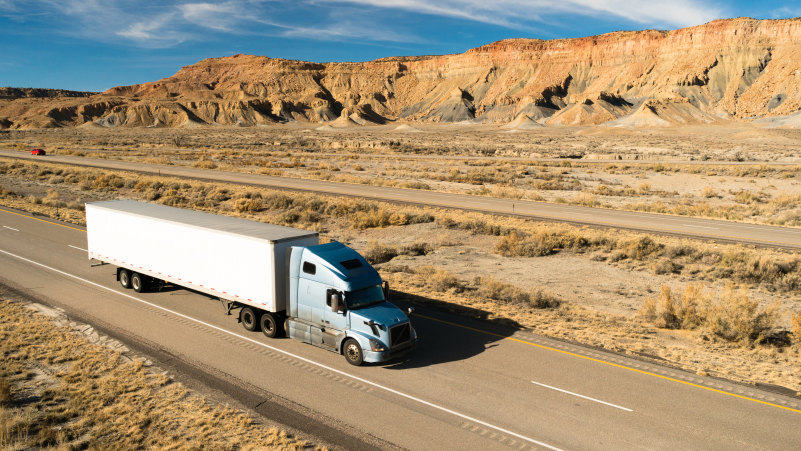







What does a truck driver actually see from the cab? Professional drivers know exactly what is visible – and above all, what is not – but many other road users are unaware that heavy vehicles have significant blind spots. Despite modern safety systems and up to six rear-view mirrors, trucks still have four invisible zones: in front of the cab just below the windscreen, behind the trailer, and on both sides. The greatest danger occurs when turning, especially to the right, when drivers may fail to see pedestrians or cyclists beside the cab. Just a moment’s distraction can be enough to cause an accident.
“The most common mistake is assuming that if we can see the truck, the driver can also see us. In reality, that’s not the case,” explains Singaras Čepaitis, head of driver training at Lithuanian logistics group Girteka. The company conducted a social experiment on visibility by inviting a group of non-drivers to sit in a stationary truck cab, while others positioned themselves in the vehicle’s blind spots. Most participants at the wheel declared that they could see a clear road, even though several people were standing just a few metres away – completely invisible from the cab. “When you first sit behind the wheel of a heavy vehicle, you realise that despite the height and mirrors, pedestrians, bicycles and even cars can vanish from view,” adds Čepaitis.
Čepaitis emphasises that the most effective way to check whether you are in a blind spot is to make eye contact with the driver. “If you can see their face through the windscreen or mirror, they can probably see you too. If you can’t, it means you’re in a blind spot,” he says. This rule applies to everyone – pedestrians, cyclists and e-scooter users alike. Even a simple gesture, such as a nod or a wave, can attract the driver’s attention and enhance mutual safety.
There are also simple everyday habits that can reduce risks: keeping a safe distance from trucks, avoiding walking directly in front of or behind them, crossing only after ensuring the driver has noticed you, wearing light or reflective clothing, and not using phones or headphones near heavy traffic. These may seem basic actions, yet many people neglect them.
To spread these good practices, Girteka has launched the Road Safety Caravan, an educational programme visiting schools across Lithuania to teach young people how to behave safely around trucks. The goal is to build awareness from an early age, so that future road users understand safety rules and the specific features of large vehicles. “The caravan will visit schools in cities and towns for several weeks,” explains Mindaugas Paulauskas, CEO of Girteka Transport. “Children should regularly receive information about road safety, especially at the start of the school year when they begin travelling independently. As days grow shorter, using reflectors becomes essential. Helping them understand where truck blind spots are and how long a vehicle needs to brake means protecting them today and preparing them for the future.”