







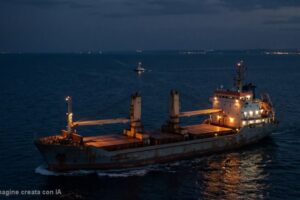

The first serious maritime incident in the Persian Gulf since the outbreak of war between Israel and Iran occurred on 17 June 2025 off the coast of Fujairah, near the Strait of Hormuz, where the two tankers Front Eagle and Adalynn collided. Although the area is relatively small, such a collision is highly unusual, raising suspicions that the satellite navigation systems of both ships may have been disrupted by war-related interference. The manipulation, suppression or spoofing of satellite signals is a known feature of modern conflicts, having also been employed in the war between Russia and Ukraine, where it has caused disruption to land, air and sea transport in parts of northern and central Europe.
The incident took place at 01:14 Dubai time on 17 June 2025, when the Liberian-flagged Very Large Crude Carrier Front Eagle collided with the Adalynn, a Suezmax tanker flying the flag of Antigua and Barbuda and suspected of being part of Russia’s so-called shadow fleet. The Front Eagle was carrying around 2 million tonnes of Iraqi crude oil bound for the port of Zhoushan in China, while the Adalynn was travelling empty towards the Suez Canal in Egypt. According to maritime tracking data from TankerTrackers.com, the Front Eagle was heading south at a speed of 13.1 knots when it suddenly veered to starboard, striking the port stern of the Adalynn, which was moving southeast at 4.8 knots. The impact sparked immediate fires on both vessels, with the Adalynn sustaining the worst damage and becoming engulfed in flames.
The United Arab Emirates Coast Guard responded swiftly, evacuating all 24 crew members from the Adalynn and transporting them safely to the port of Khor Fakkan. The crew of the Front Eagle remained on board and managed to extinguish the fire on their ship’s deck. The vessel temporarily declared itself “not under command” due to the fire. Authorities confirmed there were no casualties and, so far, no signs of environmental pollution have been detected. However, satellite data from NASA’s FIRMS system recorded thermal anomalies with radiative power of 6.5 MW and 7.78 MW, indicating intense fires on both ships.
There are credible suspicions that the vessels encountered an environment shaped by electronic warfare. Iran is known to possess advanced capabilities in this field, including the Cobra V8 system, which can disrupt reconnaissance aircraft from distances of up to 250 kilometres, and electronic warfare installations based in Bandar Abbas and on Abu Musa island. These systems have shown the ability to simultaneously disrupt GPS, AIS (Automatic Identification System) and VHF communications, creating an extremely hazardous operating environment for commercial navigation.
The Joint Maritime Information Centre, part of the US-led Combined Maritime Forces, has documented instances of extreme jamming originating from the Iranian port of Bandar Abbas. Analyses have revealed recurring circular GPS spoofing patterns. One of the most striking examples involved the Front Tyne, a sister ship of the Front Eagle, which on 17 June appeared via AIS to be located in sugar beet fields in rural Russia, while in reality it was sailing in the Gulf between Iran and the United Arab Emirates. Ami Daniel, CEO of Windward Analytics, noted that “typically, there’s no jamming in the Strait of Hormuz, but now it’s widespread. This escalation increases risk. It’s a volatile area, and if you can’t geo-locate accurately, the likelihood of an incident rises.”
Windward Analytics also identified that more than 900 vessels experienced significant navigation signal interference between 12 and 15 June 2025, with the Front Eagle suffering from persistent GPS and AIS jamming during its transit from Iraq through the Arabian Gulf. Regarding this same tanker, Kpler data shows that the Front Eagle displayed abnormal displacements of several kilometres on maritime positioning systems the day before the collision. Maritime historian Sal Mercogliano of Campbell University observed that “GPS disruption likely affected the ship’s autopilot.”
Just six days into the Israel-Iran conflict, repercussions for navigation in the Strait of Hormuz are already evident. On 9 June, 147 vessels passed through the strait, but by 17 June that number had dropped to just 100. Frontline, the largest publicly listed tanker company, told the Financial Times it had declined new contracts to transit the Gulf via the Strait of Hormuz following the outbreak of hostilities. Jakob Larsen, head of safety and security at the Baltic and International Maritime Council, confirmed that “more and more shipowners are exercising extra caution and choosing to avoid the Red Sea and the Persian Gulf.”
In these conditions, the insurance sector is the first to react. According to The Indian Express, shipping insurance premiums in India have risen by 15 to 30 percent, with insurers now applying an additional charge of 0.10 to 0.15 percent of cargo value to cover war risk. S&P Global Commodity reports that Hull & Machinery insurance premiums have increased to around 0.05 percent of H&M value for a seven-day transit through the Persian Gulf. Charter rates for tankers are also climbing. According to US broadcaster CNBC, rates for voyages from the Middle East Gulf to China jumped 24 percent on Friday 14 June, reaching 1.67 dollars per barrel, the highest daily increase of the year.
Unsurprisingly, this is driving up oil prices, despite the abundant supply seen in recent months. The trend between 12 and 18 June was marked by high volatility, with overall increases of 11.7 percent for WTI and 10.9 percent for Brent. During the week, WTI rose from 67.14 dollars per barrel to 74.98 dollars, while Brent climbed from 68.76 to 76.25 dollars per barrel. The turning point came on 13 June, with a 9 percent increase for WTI and a 7.9 percent rise for Brent, marking the biggest one-day jump for both benchmarks since March 2022, when Russia launched its invasion of Ukraine.