
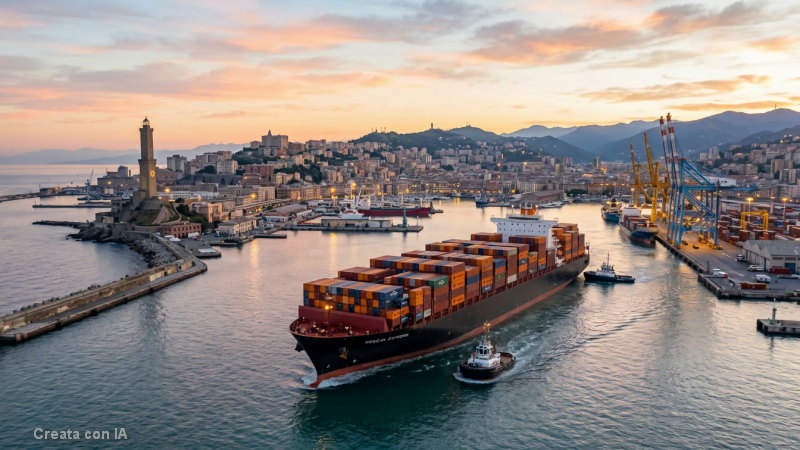








The year 2024 proved to be a dynamic one for the Russian container shipping market. Following a period of slowdown linked to the pandemic and the sanctions resulting from the invasion of Ukraine, the latest data indicate a strong rebound in volumes handled, although the sector continues to face significant logistical, regulatory and geopolitical challenges. According to operational results from Global Ports, one of Russia’s leading terminal operators, total volume handled at its seaport terminals reached 5.39 million TEUs in 2024, marking a 14.1% increase compared to the previous year. The fourth quarter alone set a historic record with 1.466 million TEUs, an 18.6% rise compared to the same period in 2023. This marks a return to the levels seen in 2021, prior to the major disruptions caused by international sanctions.
The Baltic Sea basin led the expansion, registering a 17.7% year-on-year increase in the fourth quarter and a 34.4% rise over the full year. Meanwhile, the Russian Far East, although remaining the country’s largest container hub in absolute terms, saw growth slow to 5%. The southern regions – namely the Black Sea-Azov and Caspian basins – ended the year with a 6.3% increase. A closer look at the main ports shows a 58.6% rise for Baltic ports (830,900 TEUs) and a 6.7% increase for those in the Black Sea-Azov basin (555,200 TEUs). The Caspian bucked the trend, with a 37.5% drop in volumes, due to changes in regional trade flows and the impact of regulatory restrictions.
According to analysts, several factors underpin this recovery. First is the rebound of the Russian economy, supported by domestic demand and the growth of e-commerce, which has increased the need for reliable logistics solutions. In addition, public investment in port infrastructure has improved terminal capacity, particularly in the Baltic area, where Global Ports outperformed the market average with a 27.1% year-on-year increase. There was also a surge in non-containerised cargo transport, which reached 6.6 million tonnes in 2024.
Another driver of growth is Russia’s strategy of trade diversification. The pivot towards Asian countries, particularly China, has helped sustain container traffic despite strained relations with Europe. Nevertheless, the consequences of the war in Ukraine remain significant. Rising energy prices have affected European purchasing power and thus demand, while tighter sanctions have introduced new operational hurdles.
The restrictions imposed by the European Union, including a ban on 74 ships entering EU ports, limits on transactions with maritime infrastructure, and constraints on banking finance, have forced many operators to recalibrate routes and seek alternative solutions. Difficulties with international insurance and payments continue to impact the efficiency of the logistics chain.
Further complicating the picture are measures adopted by Russia itself. In October, the transit of dual-use goods (civilian and military) was banned, affecting even seemingly non-sensitive shipments such as clothing from China. The fragmented enforcement of the directive, combined with Russia’s requirement to physically inspect each container, has caused delays and increased uncertainty for operators. A lack of transparency in appeal mechanisms has worsened the situation.
Infrastructure also presents critical issues. Ports in the Far East, among the busiest, have experienced episodes of congestion, while supply chain disruptions – stemming from both the conflict and the pandemic – continue to hamper the regular flow of goods. Drone attacks on Russian refineries have impacted fuel exports, a factor that cannot be overlooked for the stability of the maritime sector.
On the geopolitical front, additional pressure has come from Kazakhstan, which in February 2025 introduced railway restrictions on traffic with Russia without providing clear justification. These new rules risk disrupting container transport along the Asian corridor, raising concerns among Chinese companies over possible cost increases and delays.
In response to these difficulties, Moscow is pushing to develop the Arctic route. This corridor represents one of the Kremlin’s main strategic bets, with Rosatom entrusted with managing the entire infrastructure: from safety to navigation, including support from nuclear-powered icebreakers. However, the project is hampered by a shortage of suitable vessels. Projected flows for 2024 stand at around 40 million tonnes, half the official target, highlighting structural shortcomings still to be addressed.
Meanwhile, container traffic continues to present opportunities. The growth of Russia’s domestic market, the development of trade with Asia and the adoption of advanced technologies – from artificial intelligence to the Internet of Things – are helping to transform the sector. However, Russian and international sources diverge in their interpretation. While local players such as Fesco speak of resilience and structural recovery, sources like Container Trade Statistics emphasise the negative impact of sanctions and the need for a deep reorganisation to respond to new global dynamics.