




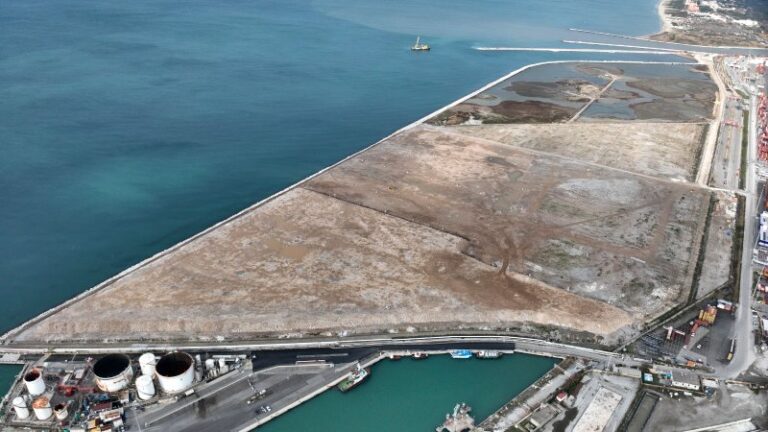
The completion at the end of December 2025 – seven days ahead of schedule – of the consolidation of the first 80,000 square metres of the initial reclamation basin marked the close of 2025 for Darsena Europa, the new container terminal at the port of Livorno. The works, carried out using the preloading technique, allowed the controlled settlement of the soils intended to host the future facility and the immediate transfer of the embankment to the next lot. The target remains the consolidation of the entire basin, covering around 37 hectares, by June 2027, in line with the deadlines set out in the official timetable.
The year-end milestone represents the culmination of twelve months that saw the project move from the authorisation phase to construction. In the early months of 2025, Darsena Europa became the focus of industrial and institutional debate. In January, the consortium made up of MSC, Fratelli Neri and Lorenzini submitted an expression of interest, confirming the attractiveness of the infrastructure and the shipping group’s intention to strengthen its presence in the port of Livorno. The move reignited discussion over the future management structure of the terminal and the mechanisms for involving private capital.
In April, the picture became more complex with the submission by the Grimaldi Group, through Terminal Darsena Toscana, of a formal request to build and operate 50 per cent of the future terminal. The proposal, accompanied by technical documentation and a private investment plan estimated at between €160 million and €180 million, introduced an alternative vision to the single-project approach supported by MSC, opening a debate set to continue beyond 2025.
The operational turning point came in spring. In May, following approval of the agreement between the Tuscany Region and the Extraordinary Commissioner, offshore works for the first phase of Darsena Europa got under way. Investment in the works currently in progress exceeds €550 million and includes the construction of breakwaters, dredging operations and the consolidation of the first reclamation basin. The project envisages a new outer breakwater 4.6 kilometres long, inner breakwaters and reclamation basins totalling 130 hectares, as well as a new access channel with depths of up to 17 metres. This scale leap is designed to allow the Livorno port to accommodate the latest generation of container ships, which are currently excluded due to draught limitations.
During the autumn, the project went through a key institutional step with the appointment of Livorno prefect Giancarlo Dionisi as extraordinary commissioner for Darsena Europa. The visit by the Minister for Transport confirmed the national importance of the project and the timetable of the works, with completion of the main infrastructure expected by October 2030. In the same period, the reactivation of the steering committee made it possible to take stock of progress and of the critical issues still unresolved.
It was precisely during the November meetings that the issue of complementary works still lacking financial cover clearly emerged. The consolidation of the second reclamation basin, the completion of last-mile rail connections, the extension of the Fi-Pi-Li dual carriageway to Darsena Europa and the construction of a new movable bridge over the Scolmatore require resources estimated at between €130 million and €150 million. According to the Port System Authority, without these interventions the infrastructure risks not being fully usable or attractive to future concessionaires.
Mara Gambetta