







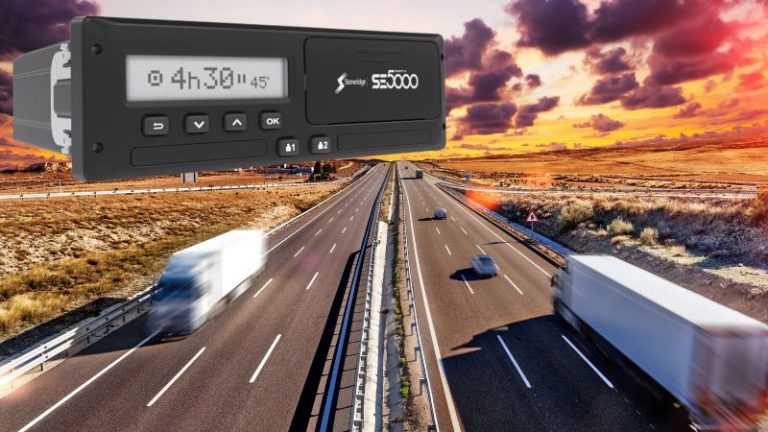
In March 2026, the European Commission published a document on the tachograph provisions of the First Mobility Package. The text covers three areas: obligations for manually recording border crossings and the criteria for identifying the first suitable stopping place; deadlines and conditions for mandatory retrofitting to the second-generation smart tachograph, with a final deadline of 18 August 2025 for vehicles already equipped with the first version; and the management of tachograph cards during the transitional period until 2028. It also clarifies cases of exemption from the retrofit obligation and the treatment of cards issued by non-EU AETR countries.
From 20 August 2020 for vehicles equipped with analogue tachographs, and from 2 February 2022 for those with digital tachographs, including the first generation of smart tachographs, drivers are required to manually enter in the device the symbol of the country they enter after crossing a border between Member States. This is set out in Regulation (EU) No 165/2014, specifically in Article 34 and the second paragraph of Article 34. The aim is to facilitate checks on cabotage operations, governed by Regulation (EC) No 1072/2009, and on driver posting rules under Directive (EU) 2020/1057. The obligation applies to all vehicles within the scope of Regulation (EU) No 165/2014, regardless of the type of operation performed.
This is a transitional measure, intended to remain in force until the second-generation smart tachograph — capable of automatically recording border crossings — is installed across the entire fleet. All vehicles first registered from 21 August 2023 must already be equipped with this device. For vehicles currently fitted with analogue or non-smart digital tachographs, the retrofit deadline was set at 31 December 2024. Vehicles already equipped with first-generation smart tachographs have until 18 August 2025. Finally, light commercial vehicles with a gross vehicle weight between 2.5 and 3.5 tonnes, used in international transport or cabotage operations, must be fitted with the new device from 1 July 2026, in accordance with Article 2 of Regulation (EC) No 561/2006.
The European Commission specifies that manual recording of the country must take place “at the first possible stop in the nearest stopping place available after the border”. The EU text uses the expression “nearest possible stopping place”, meaning the closest stopping point that is actually accessible. Assessing this condition must take into account traffic circumstances and the road safety rules in force at the time of crossing. Under no circumstances should compliance with the recording obligation compromise road safety.
In this regard, the March 2026 document provides two practical examples. In the first, the Commission clarifies that the emergency lane cannot be considered an acceptable stopping place for this purpose, as its use would violate road traffic rules. In the second, it describes a rest area with a congested or already full deceleration lane: in this situation, the driver may proceed to the next stopping place without committing an infringement. Consequently, the same rest area may be “the nearest possible” for one driver but not for another arriving at a busier time. Enforcement authorities are invited to take these factors into account when verifying compliance, while transport companies are required to provide appropriate instructions to their drivers, as set out in Article 10 of Regulation (EC) No 561/2006.
As regards tachograph cards, the document addresses the complexity arising from the coexistence of different generations of devices and cards in the period between August 2023 and August 2028. First-generation smart tachograph cards were issued until August 2023, after which Member States began issuing second-generation cards. Since the validity of cards cannot exceed five years, under Article 26 of Regulation (EU) No 165/2014, the full transition to the new system will not be completed before August 2028. By that date, all drivers operating in Member States other than the one where the vehicle is registered must hold a second-generation card.
Until then, drivers holding a first-generation card must be able to demonstrate their activities for the previous 56 days, as required by Article 36(1) and (2) of the same Regulation. Second-generation cards have sufficient memory capacity to store all required data for this period. The vast majority of first-generation cards — particularly those issued before August 2023 — also allow storage of data covering more than 56 days. However, in a limited number of cases, cards issued between August 2020 and August 2023 with lower memory capacity, combined with drivers with very frequent activity, may not contain the full set of required data. This type of overwriting is beyond the driver’s control and does not, in principle, constitute an infringement.
In such cases, the document identifies several possible solutions. As a first step, inspectors must verify whether the missing data are present in the tachograph of the vehicle being checked. If this does not yield results, the driver or the company has two alternatives: electronic transmission to the driver of data previously downloaded by the company, in accordance with Article 33 of Regulation (EU) No 165/2014, or the driver keeping printouts of their activity data for the rolling 56-day period. Member States may also require the replacement of certain cards, under Article 26 of the same Regulation, where necessary to ensure compliance with the technical specifications.
Regarding border crossings during the transitional period, the Commission clarifies that once a vehicle is equipped with a second-generation smart tachograph, automatic recording of border crossings takes place regardless of the generation of the card in use. No manual recording is therefore required, even if the driver’s card does not support automatic storage of this data. Enforcement authorities may, where necessary, read the data directly from the vehicle’s tachograph.
A separate issue concerns drivers from third countries that are signatories to the European Agreement concerning the Work of Crews of Vehicles Engaged in International Road Transport (AETR). Many of these countries still issue non-smart digital tachograph cards, which do not have the functionalities of second-generation cards. Regulation (EU) No 165/2014 applies to vehicles registered in the EU, but the document emphasises that companies and drivers must verify “normal residence” under Article 26 of the same Regulation when a driver from a non-EU AETR country starts working for a company established in the EU. Upon expiry of the original card, the driver may apply for a card issued by an EU Member State, under Articles 30 and 28 of the Regulation. In the meantime, they must still be able to demonstrate compliance with the applicable obligations, including providing data for the previous 56 days.
Among non-EU countries, the document identifies those applying rules identical to EU provisions on smart tachographs: the United Kingdom, Norway, Liechtenstein, Iceland and Switzerland. Bosnia and Herzegovina and Serbia, as signatories to the Treaty establishing the Transport Community, have obtained from the European Commission the cryptographic certificates required to issue smart tachograph cards. Vehicles registered in Ukraine may be equipped with smart tachographs, and the corresponding cards are recognised in the EU under the bilateral road freight agreement, as established by Decision No 2/2025 of the Joint Committee set up under that agreement on 17 January 2025.
The obligation to retrofit to the second-generation smart tachograph, provided for by Regulation (EU) No 165/2014, applies to vehicles registered in the Union that operate in Member States other than the one of registration. The document precisely clarifies the cases in which this obligation does not apply. A vehicle registered in Romania carrying out transport exclusively between Romania and North Macedonia, transiting through Bulgaria, falls under the scope of AETR rather than Regulation (EC) No 561/2006 and is therefore not subject to the retrofit obligation. Conversely, if the same vehicle is used for an operation carried out entirely within the EU, the obligation applies from the start of that journey, and the retrofit must be completed before departure. Likewise, simple transit through another Member State during a national transport operation does not constitute an international operation under Article 2 of Regulation (EC) No 1072/2009 and therefore does not trigger the retrofit obligation.
Pietro Rossoni