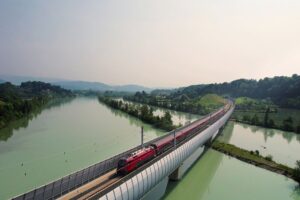






12 December 2025 will be remembered as a historic date for Austrian railways, as it marks the entry into service of one of the country’s largest infrastructure projects, the Koralmbahn, or Koralpe railway. This new 130-kilometre line crosses southern Austria from Klagenfurt to Graz. The heart of the project, and its main engineering landmark, is the base tunnel, almost 33 kilometres long, which represents a real turning point in terms of line speed and high capacity for the entire southern Austrian rail network.
Commercial rail services began on 14 December, but here too, as had already happened in Switzerland with the Alptransit tunnels, freight trains anticipated the official opening and started running on the new Koralmbahn as early as the beginning of November 2025. This allowed on-site verification that the complex safety and signalling systems were fully reliable. For the record, according to some accounts reported by the local press, there were also a few minor unexpected incidents, such as a train raising so much dust that it triggered the fire detection systems.
However, this initial phase reserved for freight-only operations cannot necessarily be seen as a good omen, because the new railway risks having to deal with what already looks like success beyond expectations. The Koralmbahn will be used by numerous regional and long-distance passenger services, which will therefore have to coexist, not without difficulty, with freight traffic. One example is the Railjet EuroCity service from Trieste to Vienna, introduced precisely from 14 December and operated by the Austrian railways ÖBB, taking advantage of the speed offered by the new alignment with the base tunnel.
It cannot therefore be ruled out that freight traffic will be selected according to train type, and thus according to path speed and hauled mass. Some freight trains will continue to use the more northerly route via Sankt Veit an der Glan and Leoben, no longer used by fast passenger services. The Koralmbahn includes 50 kilometres of tunnels, including the base tunnel, as well as more than one hundred bridges and viaducts.
The line forms part of the European Baltic–Adriatic corridor and is classified as a high-performance railway, as it has been designed for speeds of up to 250 km/h. The first construction works began in 1999 and were completed almost 27 years later. A first section, in the Graz area, entered service much earlier, together with the initial alignment on the Klagenfurt side, but without the base tunnel the new railway axis effectively remained on paper until the very end.
Total investment has exceeded six billion euros, financed in part by the Austrian federal government, ÖBB and the Länder of Styria and Carinthia, as well as by European contributions through the local PNRR and the Connecting Europe Facility programme. Alongside the new Koralmbahn, the Austrian railways have pursued a much broader programme of works, including the upgrading and enhancement of the Southern Railway, the Südbahn, between Vienna, Graz, Klagenfurt, Villach and the Italian and Slovenian borders.
Piermario Curti Sacchi