





- Amazon has acquired Rivr, a Zurich-based startup that has developed a robot capable of climbing stairs and navigating pavements and driveways, to automate the final metres of delivery between the van and the customer’s door. The deal followed earlier investments by the Amazon Industrial Innovation Fund and Bezos Expeditions in the company’s 2024 funding round.
- A few days later, the e-commerce giant acquired New York-based Fauna Robotics, maker of Sprout, a bipedal humanoid robot designed to operate in shared human spaces such as homes, schools and retail environments. The founders and team will remain in New York within Amazon’s personal and consumer robotics division.
- These two acquisitions form part of a strategy launched in 2012 with the purchase of Kiva Systems, which transformed Amazon from a robotics customer into a producer and integrator of proprietary systems. The recurring model is consistent: invest first, test in real-world conditions, then acquire when the technology becomes critical to the value chain.
Amazon has made a double move in robotics. In mid-March 2026 it acquired Rivr, a Zurich-based startup specialising in autonomous delivery robotics, and shortly afterwards Fauna Robotics, a New York company producing humanoid robots designed for social environments. The two deals, announced almost simultaneously, signal that Amazon no longer considers warehouse automation sufficient. The objective is now to extend robotic presence to the threshold of the customer’s home, and potentially beyond.
Rivr’s robot is often described in the startup’s technical materials as a “dog on roller skates”: it combines wheels and legs, reaches speeds of up to around 15 kilometres per hour, and is designed to cover the final stretch between the delivery van and the front door. Its ability to climb stairs, traverse driveways and move along pavements sets it apart from traditional warehouse robots, which operate in structured and predictable environments. Amazon has not issued an official statement on the acquisition, but informed its delivery partners through an internal letter, describing Rivr’s technology as a tool to “increase safety and efficiency” in the final stages of delivery. Financial terms were not disclosed; the startup had raised around $25 million (approximately €23 million), including $22.2 million in a 2024 round backed by Amazon’s Industrial Innovation Fund and Bezos Expeditions, with an estimated valuation of about $100 million (approximately €92 million).
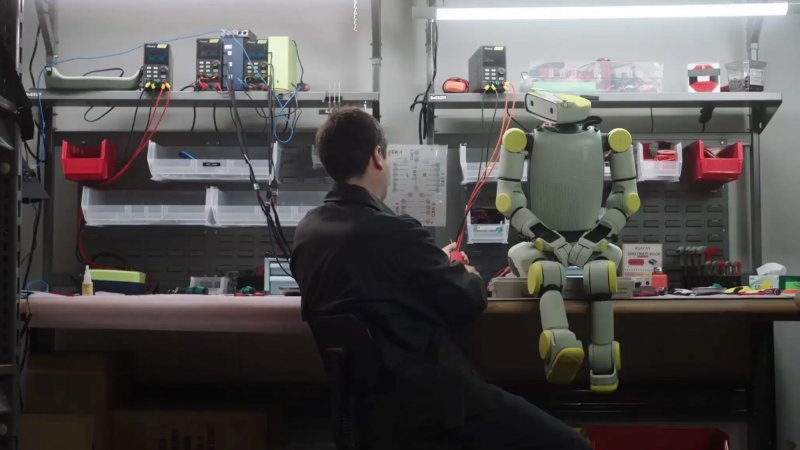
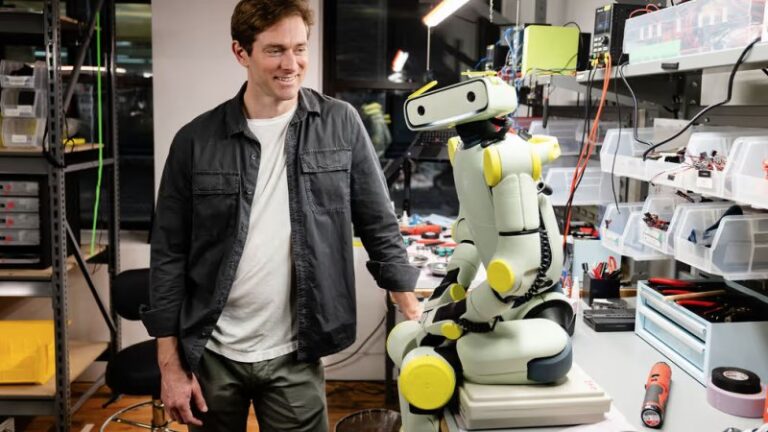
Fauna Robotics has a more recent history and a different positioning. Founded in New York, it launched its first product, Sprout, in January 2026: a bipedal humanoid robot about 1.06 metres tall, with a deliberately non-industrial design, a rectangular head and movements intended to appear expressive rather than threatening. It weighs around 59 kilograms and is priced at approximately $50,000 (around €46,000), placing it mainly within reach of corporate laboratories, universities and research and development centres. Sprout is not designed for heavy lifting but to operate in shared environments: it can grasp light objects, move between tables and chairs, interact with adults and children. Amazon confirmed that Fauna’s founders and team will remain in New York and join its personal and consumer robotics division, continuing to operate as “Fauna Robotics, an Amazon company”. Financial terms were not disclosed in this case either.
Together, the two acquisitions effectively close a loop opened in 2012, when Amazon acquired Kiva Systems for around $775 million (approximately €714 million), bringing in-house a platform of mobile robots for storage and picking operations in warehouses. This marked a structural turning point: after the acquisition, Amazon withdrew Kiva technology from the external market, ceasing sales to other distribution operators and turning it into a proprietary competitive advantage. Over time, Amazon’s warehouse robot fleet has grown to more than one million units deployed globally, according to company estimates.
In subsequent years, Amazon replicated this model through targeted acquisitions. In 2019 it bought Canvas Technology, a startup specialising in autonomous robots for indoor environments using computer vision, enhancing the flexibility of its handling systems compared with traditional automated guided vehicles. In 2020 it acquired Zoox, a California-based autonomous vehicle company valued at around $1.2 billion (approximately €1.1 billion), formally positioned in passenger transport services but with clear implications for urban logistics. Throughout the 2020s it also integrated Dispatch and other experimental last-mile delivery projects, alongside its drone programmes.
In 2022 Amazon acquired Cloostermans, a Belgian company and partner since 2019 specialising in mechatronic systems for handling pallets, containers and packaging. The deal followed the same logic as Kiva: a strategic supplier with which Amazon had long collaborated was internalised, removing a technology from the market that other logistics operators were using or could have used. Industry analysts have noted that this repeated pattern of acquiring key suppliers progressively reduces the competitive space available to other players in the supply chain.
An attempt in a different direction ended unsuccessfully: in 2022 Amazon announced the acquisition of iRobot, maker of the Roomba domestic robot, but the deal was blocked in 2024 due to regulatory hurdles. Even without completion, it had already signalled Amazon’s interest in mass-market consumer robotics. Fauna Robotics reopens that front, but with a different approach: not a standardised cleaning robot, but a developer platform on which to build future use cases.
Amazon’s overall robotics strategy can be seen as a progression in three phases. The first, initiated with Kiva and reinforced by Canvas and Cloostermans, concerns back-end automation: storage, internal handling, sorting and packaging. The second phase, involving Zoox, Dispatch and now Rivr, focuses on last-mile delivery, particularly on tasks that still require a driver’s physical presence, such as parking, exiting the vehicle, walking along driveways and climbing stairs. The third phase, opened by Fauna Robotics, involves entering domestic and social environments, where the robot is no longer a logistics tool but an interaction platform.
Within this framework, the Amazon Industrial Innovation Fund, a $1 billion vehicle launched in 2022, acts as a bridge between technology scouting and acquisition. It invests in startups in logistics, robotics and computer vision, evaluates their technologies in real-world settings and, when they become critical to Amazon’s value chain, paves the way for corporate integration. Rivr is a direct example of this mechanism, having received funding from the Innovation Fund prior to its acquisition.
On the competitive front, Amazon is now operating in a segment—humanoid robots for civil environments—where other major technology and industrial players are active, including Tesla with its Optimus project, Figure and Agility Robotics. However, Sprout’s positioning differs from industrial robots designed to replace warehouse workers: it is a “developers-first” platform, as Fauna itself describes it, intended for experimenting with assistance services, entertainment, elderly care and retail applications. Integration with the Alexa ecosystem and Aws cloud services is among the scenarios most frequently cited by industry analysts.
Several questions remain unresolved by the March 2026 acquisitions. From an employment perspective, the introduction of delivery robots such as Rivr’s raises concerns about the future demand for drivers and couriers working with Amazon’s partners. From a privacy standpoint, the entry of humanoid robots into domestic environments revives concerns already raised during the iRobot debate regarding the collection and management of data generated by in-home devices. Finally, from a competition perspective, the ongoing absorption of key technology suppliers further narrows the space available to other logistics operators that may need access to the same technologies to compete.
M.L.