



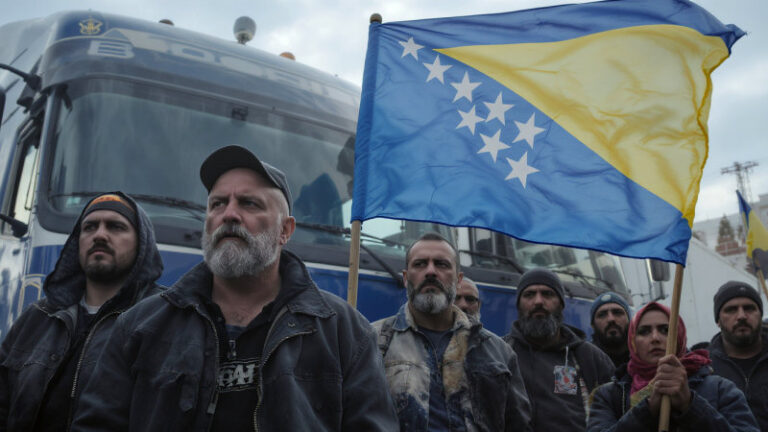
At the beginning of September 2025, Bosnia and Herzegovina witnessed one of the largest truck driver protests in recent years. From the first day of the month and for three consecutive days, hauliers blocked major road arteries, border crossings and supply chains, triggering widespread paralysis that affected not only freight but also passenger traffic. At the centre of the protest was the association Logistika, which represents 93 per cent of the country’s freight transport and brings together around 47,000 workers across 600 companies. Led by chief coordinator Velimir Peulic, the organisation promoted the action under the slogan “Enough is enough”, leveraging the economic weight of a sector worth a total of €4.7 billion. Thanks to its dominant position, Logistika managed to mobilise some six hundred industrial vehicles, deployed at strategic points near customs terminals and along the borders with Croatia and Serbia, and to bring out enough participants to enforce an almost total blockade of freight transport.
The spark for the protest was the strict application of the so-called ninety-day rule introduced by the European Union, which limits the stay of Bosnian hauliers in EU territory to a maximum of three months every 180 days. The way the rule is calculated, counting each border crossing as a full day, particularly penalises those working on short-haul routes. For example, a driver travelling several times a day from Mostar to the Croatian port of Ploče, just seventy kilometres away, sees three days of stay counted within a few hours of work. This interpretation has already led to penalties against 48 Bosnian drivers in various EU countries, accused of exceeding the time limit despite carrying out their regular professional activity.
Beyond the European issue, hauliers put forward broader demands: equal treatment with their EU counterparts under the Aetr agreement, reimbursement of half of fuel excise duties and a corresponding discount on motorway tolls, recognition of service exporter status granting tax advantages, simplification of customs and border procedures, and finally a reform of domestic rules on driver training, currently expensive and hindered by long entry times to the profession. According to Logistika, the weight of bureaucracy and excessive costs has already pushed many companies to relocate to neighbouring EU countries such as Croatia and Slovenia, resulting in job losses and a drain of expertise for Bosnia.
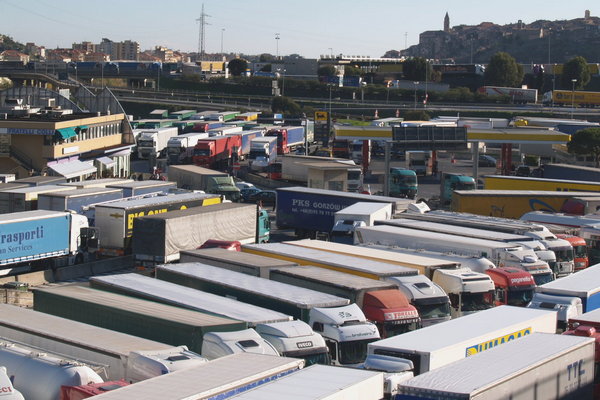
The effects of the strike were immediate. The Auto-Moto Club Bihamk reported the near-total closure of the main border crossings for goods, including Izačić, Bijača, Orašje, Gradiška and Rača. More than 20,000 tonnes of freight were stranded, main roads were clogged with kilometres-long queues, and passenger traffic was also caught up in the slowdown, despite not being the initial target of the protest. The capital Sarajevo was among the hardest hit, with about 4,000 tonnes of goods stuck and traffic almost paralysed. The protest also reverberated across the borders, particularly at the Ličko Petrovo Selo-Izačić crossing between Croatia and Bosnia, which was completely blocked, with significant effects on regional trade flows.
On the political front, the Minister of Communications and Transport, Edin Forto, tried to defuse tensions, claiming that most of the hauliers’ demands had already been met and acknowledging that the ninety-day issue could only be resolved through EU-level legislative change. In sharp contrast, the president of Republika Srpska, Milorad Dodik, seized the opportunity to revive his separatist positions, describing the country’s current institutional set-up as a “systemic mistake” and calling for Forto’s resignation. Dodik expressed full support for the hauliers, even promising them food and water, in a clear attempt to exploit the protest for internal political purposes.
The protest came to an end on 3 September, after the government agreed to meet most of the demands. The deal, reached on the evening of 2 September, allowed roads and borders to reopen. However, the underlying issues remain unresolved, starting with the European regulation, which will be the subject of a meeting scheduled for 10 September in Belgrade between representatives of the transport sector from across the Balkans and officials of the European Commission. The goal is to secure a relaxation of restrictions and a longer permitted stay for non-EU workers.