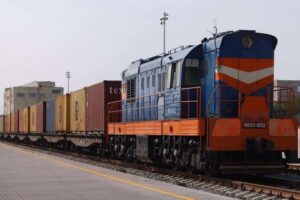







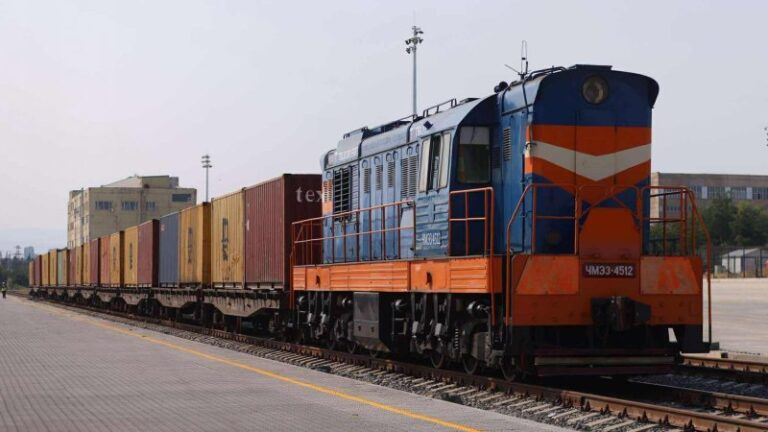
Inaugurated in 2017 with the aim of creating a land link between China and Europe, the railway connecting Azerbaijan, Georgia and Türkiye is confirming, less than a decade on, its role as a new Silk Road, shortening transport times compared with sea routes. Known as BTK (Baku–Tbilisi–Kars), it is one of the most significant sections of the Middle Corridor and will gain an important new logistics component in 2026.
Georgian Railways have announced the construction of a new terminal in Akhalkalaki, around thirty kilometres from the Turkish border. The facility had long been planned but never scheduled. The terminal will sit in a strategic position between Tbilisi, the Georgian capital, and Kars, where the BTK line connects with Türkiye’s main rail network.
The new cross-border corridor is set to become increasingly important. The railway has been designed to handle just over six million tonnes of freight per year initially, with the potential to reach 17 million tonnes by 2034. The next objective, to be achieved by 2026, is full digitalisation of all procedures, including customs processes. According to Georgian Railways, this will halve transit times, cutting them from the current 22–24 hours to only twelve.
The BTK railway is not the only project nearing completion. Attention is also on another scheme known as the Zangezur Corridor, sometimes referred to as the Nakhchivan Corridor, which is intended to link Azerbaijan with its Nakhchivan exclave, located between Armenia and Türkiye, via Armenia’s Syunik province. The geopolitical situation here is far more complex, as the conflict in this region – known as the Nagorno-Karabakh war – ended only in 2020.
However, prospects may now be shifting, especially given the unexpected interest shown by the US administration in creating a network running south of the BTK line. This would provide two alternative routes connecting Baku, and therefore the Caspian Sea, with Türkiye and onwards to Europe along the Middle Corridor.
The commercial dynamism of the region and the growing importance of its transport infrastructure are evident in several examples. One is the Tbilisi Dry Port in Georgia, inaugurated only in April 2025, which is already attracting major operators. Among them is Medlog, the logistics arm of MSC, which has launched a rail service linking the Tbilisi Dry Port with the Georgian Black Sea ports of Poti and Batumi.
Medlog’s connection significantly cuts container transit times between the hinterland and the ports, improving connectivity with the international maritime routes operated by MSC. The new rail link also strengthens the function of the dry port as an intermodal hub, integrating storage and container-handling services. The initiative is designed to support trade flows between Asia and Europe. Beyond Medlog’s new service, Georgia and Azerbaijan have also recently agreed to launch a connection between the Caspian Sea and the Black Sea.
Piermario Curti Sacchi