








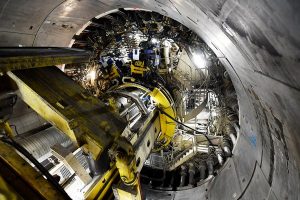
The cross-border section of the new high-capacity Turin-Lyon railway line will open to commercial traffic by 31 December 2033. The timetable for the works, which are now at an advanced stage, was updated by Italian Cipess, the Comitato interministeriale per la programmazione economica (Interministerial Committee for Economic Planning), at its meeting on 29 April 2026. As well as setting a firm date for completion of the project, assuming funding is disbursed regularly, the committee also officially confirmed the total cost of the investment: the cross-border section between Italy and France, which includes the Mont Cenis base tunnel, will require overall spending of €14.7 billion, compared with a previous estimate of €11.1 billion.
At the same meeting, Cipess authorised a financial commitment of €1.42 billion to allow ongoing works to continue. Part of this amount, specifically €428 million, is expected to come from European funds. The conditional tense is necessary because, while Europe has never politically called into question its commitment to supporting the project, which is part of one of the main Ten-T cross-border corridors, allocations in practice follow the strict budget planning adopted by Brussels.
In July 2024, the European Union approved the allocation of €700 million, resources included under the Connecting Europe Facility, covering a significant part of the cross-border section. The EU’s stated objective, expressed in several institutional settings, is to contribute up to 40%, with the possibility of reaching 50-55% for some sections, through funding to be entered in the 2028-2035 budget programme. However, the timing still remains to be verified. All this comes as Telt, the Italian-French promoter responsible for building and subsequently managing the cross-border section, expects spending commitments to exceed €1 billion in the 2026 financial year alone.
The Italian-French section of the Turin-Lyon line extends for 65 kilometres between Susa/Bussoleno in Piedmont and Saint-Jean-de-Maurienne in the French Savoie. The main element of the project is the 57.5-kilometre Mont Cenis base tunnel, of which 12.5 kilometres are in Italy and 45 kilometres in France. It will connect the international stations of Saint-Jean-de-Maurienne and Susa, or alternatively Bussoleno, which serve as connection points with the respective national lines.
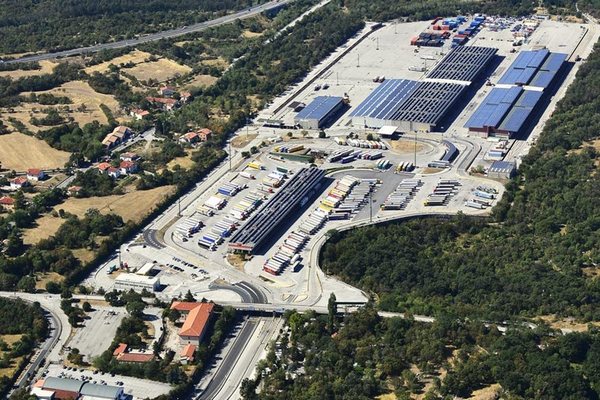
Work on the base tunnel is continuing across all sites, both above ground and underground, with 47.6 kilometres completed out of a total of 164 kilometres, including 20.5 kilometres of the base tunnel itself. In particular, the even-numbered tube at the La Praz site is now continuously passable for more than 12 kilometres. At Saint-Julien-Montdenis, excavation on the two tunnels is progressing on both fronts, while operations are continuing in parallel for the final lining of the even-numbered tube. At Saint-Martin-la-Porte, where the Viviana tunnel boring machine is operating, conventional excavation is also advancing, with several active fronts in both directions. In the Villarodin-Bourget/Modane area, 500 metres below ground, preparatory works are continuing ahead of the arrival of the two “moles”.
In Italy, work is progressing on the preparation of the Salbertrand site, together with construction site set-up for the start of excavation of the base tunnel. The project for the rail bypass between Turin Orbassano and Avigliana, which forms a segment of the national access line to the cross-border section, is now in the consultation phase with local stakeholders.
Piermario Curti Sacchi