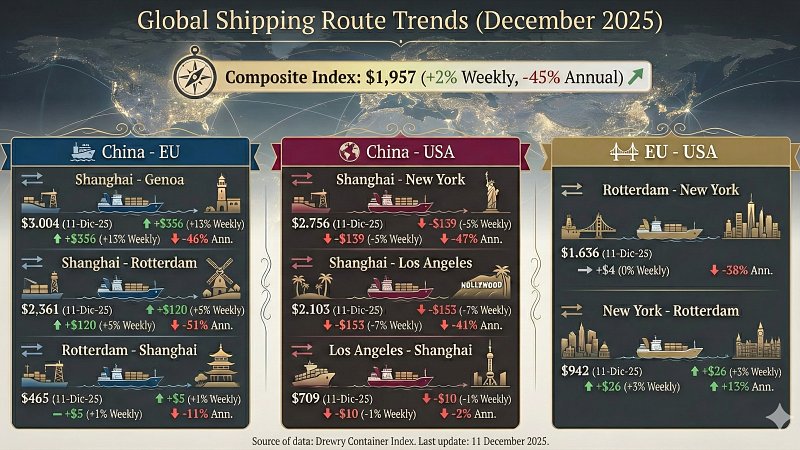







Unless postponed once again, as has often happened with tariffs, the new port charges will take effect on 14 October and will specifically target ships linked to China, whether by construction, ownership or management. The measure, pushed forward by Washington to reduce reliance on the Asian giant’s shipbuilding industry, will force leading international carriers to redistribute fleets and recalibrate transpacific services.
The new tariff framework introduces a differentiated regime with potentially enormous financial implications for operators. Ships managed by Chinese companies will initially pay 50 dollars per net ton, rising to 140 dollars by 2028. Vessels merely built in China, even if owned by non-Chinese carriers, will face their own scale of charges, starting at 18 dollars per net ton or 120 dollars per container, increasing respectively to 33 and 250 dollars. The tax may be levied up to five times a year for each ship. In practical terms, a 10,000 teu container vessel with a net tonnage of 70,000 could, over three years, pay between 3.5 and 9.8 million dollars in additional port dues.
Unsurprisingly, the main shipping lines have already begun adjusting their strategies. CMA CGM has said it will deploy tonnage built in non-Chinese yards to serve the US market. With fewer than half of its roughly 670 vessels of Chinese origin, the French carrier believes it can redeploy without major disruption. Maersk also looks relatively shielded, with only 10 per cent of its fleet affected by the new rules. The Danish operator has already confirmed that vessels built in China will be redirected to other markets rather than deployed on US routes. The picture is more complex for Zim, which operates over half of its US port calls with Chinese-built ships, many on long-term charters. With nearly half of its overall capacity tied to the Asia–North America trade, the Israeli line faces particular exposure.
One factor mitigating the impact for carriers is the contraction in container traffic between China and the United States, driven by economic and geopolitical headwinds. At least six weekly services on the route have been suspended, representing a potential loss of more than 1.3 million forty-foot containers annually. At the same time, blank sailings have multiplied, with unused scheduled capacity jumping from 60,000 to nearly 370,000 teu within weeks. The result has been a sharp reduction in available slots, with supply down 12 per cent between Asia and the US West Coast and 14 per cent on the East Coast. Hapag-Lloyd has already cut 30 per cent of its direct sailings from China, while Kuehne + Nagel reports a collapse in bookings of between 25 and 30 per cent.
The scaling back of flows into the United States is feeding growth elsewhere, particularly in ASEAN markets, Africa and the European Union. Hapag-Lloyd has highlighted strong demand from Southeast Asia, with Thailand, Cambodia and Vietnam leading the way. Yet none of these markets can fully offset the loss of China-related volumes. Another scenario under discussion involves shifting traffic to Canadian and Mexican ports, which could act as alternative gateways for cargo ultimately bound for the United States, to the benefit of transcontinental rail operators such as Canadian National and Canadian Pacific Kansas City.
The new US tariff structure also threatens to distort competition. Lines such as Evergreen, HMM and Yang Ming appear well placed thanks to their limited exposure to Chinese-built tonnage, while operators like Zim and CMA CGM will face greater strain. Nevertheless, Chinese shipyards remain central to the industry. MSC has reiterated its intention to continue ordering newbuildings in China, stressing the expertise and capacity the country continues to offer.