








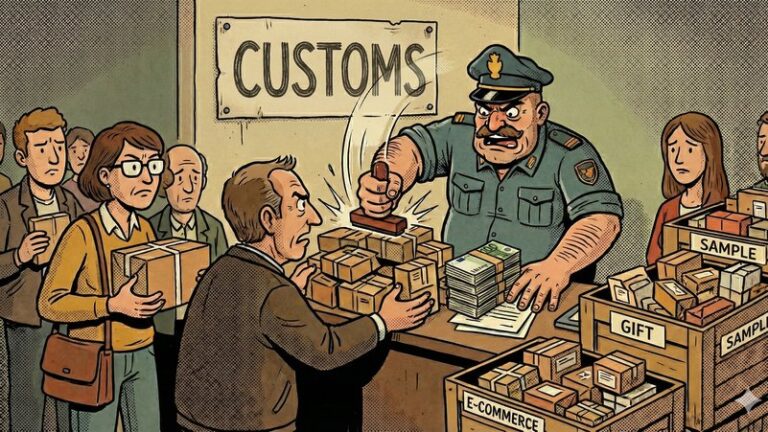
On 11 December 2025 the Ecofin Council approved the introduction of a temporary fixed customs duty of €3 for each parcel with a value below €150 originating from non-EU countries. The measure will come into force on 1 July 2026 and represents a significant break in the management of low-value e-commerce flows, which in recent years have placed growing pressure on European customs and logistics systems.
The decision is a response to the exponential increase in micro-shipments delivered directly to end consumers. According to figures cited by the European Commission, around 4.6 billion parcels below the €150 threshold entered the single market in 2024, almost double the 2.4 billion recorded in 2023 and more than three times the 1.4 billion registered in 2022. Ninety-one per cent of these consignments originated in China, highlighting the dominant role of large non-EU marketplaces in direct distribution to Europe.
Alongside rising volumes, Brussels has flagged a structural issue of goods being undervalued. Estimates suggest that up to 65% of small parcels declared below €150 carry values that do not reflect their actual contents, with the aim of avoiding standard customs duties. This practice has a direct impact on public revenue and distorts competition, penalising European companies that comply with customs, tax, environmental and product safety rules.
The temporary €3 duty will apply to shipments valued under €150 from non-EU countries, with a particular focus on e-commerce-related consignments. The charge will primarily affect non-EU sellers registered under the Import One Stop Shop VAT scheme, which accounts for around 93% of e-commerce flows into the Union. The temporary nature of the measure is linked to a broader reform process already agreed at European level, which the permanent removal of the duty-free threshold and the application of standard tariffs based on the type of goods.
This structural shift will be accompanied by the launch of the EU Customs Data Hub, a centralised digital platform designed to collect and make available real-time data on goods entering the European market. Under the current timetable, the system is expected to become operational for e-commerce platforms in 2028, with a possible early rollout at the end of 2026, while participation will become mandatory for all economic operators by 2038.
Under the new framework, e-commerce platforms will take on a direct role in customs management. They will be responsible for calculating and collecting duties and VAT at the point of purchase, ensuring the accuracy of data transmitted to the authorities and guaranteeing product compliance with EU standards. This shift is set to have significant implications for logistics organisation, the management of near-market warehouses and shipment consolidation strategies.
From an economic perspective, the impact on consumers has been estimated by Italian consumer association Codacons at around €13.8 billion per year, based on applying the fixed charge to the 4.6 billion parcels under €150 handled annually. The association notes that the cost is likely to be passed on to end buyers, with particularly marked effects on low-value purchases.