








Drewry’s composite World Container Index, calculated each week on average spot freight rates for container shipping, closed on 11 June 2026 at $3,549 per 40-foot unit, up 3 per cent, or $116, on the previous week. Year on year, the index remains unchanged at zero, signalling a structurally balanced position compared with 12 months earlier, although short-term pressures are clearly pointing upwards.
According to Drewry, the main driver of the weekly increase is the earlier start of the peak season compared with previous years, a trend confirmed by several independent sources. This is supporting stronger demand and, as a result, higher rate levels. The picture is reinforced by the diversion of vessels from Suez to the Cape of Good Hope, which is extending transit times and prompting importers to bring forward bookings to ensure goods arrive on time. Retailers are also rebuilding inventories earlier than usual ahead of major commercial events such as Amazon Prime Day and TikTok’s mid-year promotions, scheduled between June and July.
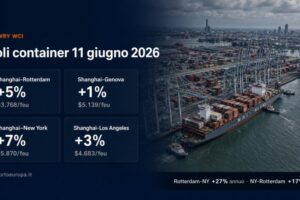
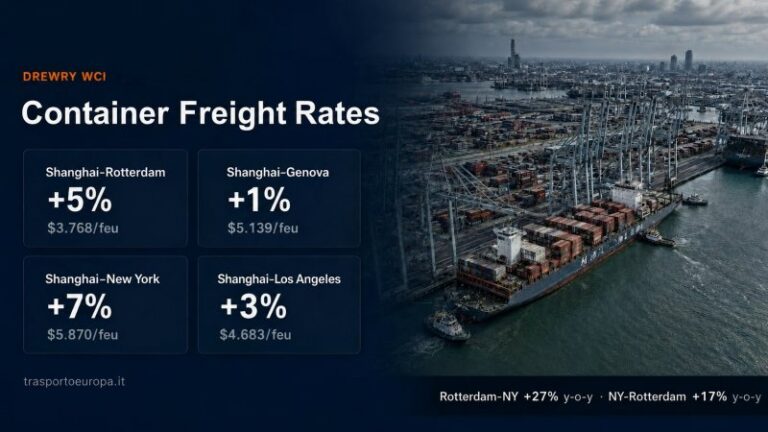
On the Asia-Europe corridor, freight rates posted broad increases, although these were far more moderate than in the previous week. Shanghai-Rotterdam recorded the strongest growth of all the routes tracked by the WCI, jumping 5 per cent to $3,768 per FEU and taking the year-on-year comparison to plus 33 per cent. On the return Rotterdam-Shanghai route, the increase was smaller, up 1 per cent to $624, with a 22 per cent rise compared with a year earlier. Shanghai-Genoa gained 1 per cent to $5,139 per FEU, up 27 per cent year on year.
Drewry also attributes the upward trend on Asia-Europe to demand being brought forward ahead of the expected bunker fuel price increase on 1 July, which is accelerating shipment flows in June. In this context, shipping lines continue to announce further rate adjustments. MSC has announced new freight-all-kinds rates effective from 15 June, set at $6,000 per 40-foot container on the Asia-North Europe route and $6,500 per 40-foot container on the Asia-West Mediterranean route. CMA CGM and ONE have also announced peak season surcharges of between $500 and $600 per 20-foot container, effective from 15 June.
On the transpacific, increases were even sharper in absolute terms. Shanghai-New York posted the highest weekly percentage change of all the routes in the WCI basket, up 7 per cent, with a $365 increase in absolute terms, taking the rate to $5,870 per 40-foot container, according to the WCI of 11 June 2026. Shanghai-Los Angeles rose 3 per cent to $4,683. Both routes, however, remain firmly negative year on year, down 19 per cent and 21 per cent respectively, showing that despite the recovery of recent weeks, current levels remain below those recorded in June 2025.
Drewry reports that only three blank sailings were announced on the transpacific route for the week following the update, indicating relatively stable capacity. Demand is being supported by forward bookings from freight forwarders ahead of potential changes to US tariffs expected in July, as well as additional demand linked to the Fifa 2026 World Cup. Maersk has announced a peak season surcharge of $1,000 per 20-foot container and $2,000 per 40-foot container, effective from 17 June. In light of these factors, Drewry expects freight rates to rise further in the coming weeks on both transpacific routes.
The only corridor to record a decline during the week was the transatlantic. Rotterdam-New York fell 2 per cent to $2,508 per 40-foot container, while the opposite New York-Rotterdam route lost 1 per cent to $956. Year on year, however, both routes remain in positive territory, with Rotterdam-New York up 27 per cent and New York-Rotterdam up 17 per cent.
Mara Gambetta