






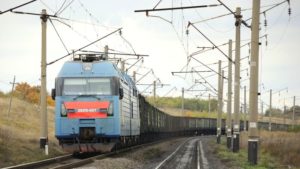
In terms of length, it cannot be considered a major infrastructure project, but from a geopolitical perspective the figures take on a completely different meaning. With just 22 kilometres of track, Ukraine has anchored itself to Europe with a line built to the standard 1,435-millimetre gauge, instead of the national 1,520-millimetre gauge inherited from the Russian Empire. Ukrainian Railways, UZ, began building this line from scratch in 2024 and has now completed the project in less than a year.
The new section links Chop with Uzhhorod in the country’s western region, creating a direct connection with Hungary and Slovakia. Uzhhorod, the historical capital of Transcarpathia, has thus become the first major regional hub to gain a direct rail link with the European Union. Ukrainian Railways views this project as only the first step in developing a broader standard-gauge network.
Despite the ongoing conflict with Russia, UZ plans to accelerate the process. By 2026 the line will be electrified and work will begin on a new corridor towards Lviv, near the Polish border, scheduled for completion within three years. The Chop–Uzhhorod line, which required an investment of under 30 million euros, was co-financed by the European Union through the Connecting Europe Facility programme and by the European Investment Bank.
To fully grasp the significance of Ukraine’s decision and the commitment it entails, a closer look at the technical aspects is essential. Beyond the areas historically tied to the Russian Empire, including Ukraine, the Iberian Peninsula – Spain and Portugal – also uses a railway gauge different from the European standard of 1,435 millimetres.
Spain, after adopting the European standard in 1992 for the construction of its first high-speed line between Madrid and Seville, launched a conversion plan that will gradually affect all the main routes included in the TEN-T trans-European corridors. The aim is to foster freight transport with the rest of Europe. This transformation is being carried out through the adoption of dual gauge. It is not seen as a permanent arrangement but rather a long, perhaps overly protracted, transition, although it has never been formally announced as such.
This solution is possible because the traditional Iberian gauge is broad but different from the Russian one. In Spain and Portugal it measures 1,668 millimetres, a significant gap compared to the 1,435-millimetre standard. This allows enough space for a third rail to be installed, something technically viable along open track without excessive costs, although switches are more complex to manage.
The Russian gauge, on the other hand, is 1,520 millimetres, too close to the European standard to allow a third rail. The only option is to lay four alternating rails, with 1,435 and 1,520 millimetres on the left and the same on the right. While technically possible, this is a costly and cumbersome solution, with limited practical applicability. This explains the Ukrainian choice: the country cannot adapt its rail links to Europe by simply adding a third rail but must build entirely new stretches of track in standard European gauge, in varying lengths and configurations.
Piermario Curti Sacchi